Datura: Difference between revisions
From WikiMD's Wellness Encyclopedia
No edit summary Tag: visualeditor-wikitext |
No edit summary |
||
| Line 1: | Line 1: | ||
{{short description|Genus of poisonous plants potentially psychoactive}} | {{short description|Genus of poisonous plants potentially psychoactive}} | ||
Pronounced da-tu' -rah, [Hind., dhatura, a certain plant], it is a genus of [[Solanacece]], or nightshade family. | Pronounced da-tu' -rah, [Hind., dhatura, a certain plant], it is a genus of [[Solanacece]], or nightshade family. | ||
Latest revision as of 15:32, 22 December 2024
Genus of poisonous plants potentially psychoactive
Pronounced da-tu' -rah, [Hind., dhatura, a certain plant], it is a genus of Solanacece, or nightshade family.
Species[edit]
- Dantura arbor ea is a South American spe- cies; the leaves are used as an emollient.
- Dantura ceratocaula is indigenous to tropical America; its properties are similar to those of D. stramonium.
- Dantura fastuosa is found through- out the tropics of the old world.
-
 Datura
 -
 Datura metel 'Fastuosa'
 -
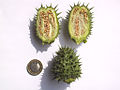 Datura Stramonium Samenkapsel
 -
 Köhler Datura
 -
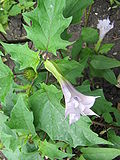 Datura stramonium


.jpg)
Traditional Islamic Medicine[edit]
- The root is administered by Mohammedan physicians in epilepsy.
- The fruit, seeds, and leaves are used in poultices for boils, carbuncles, and in the treatment of herpetic diseases. A tincture and decoction are given as a remedy for asthma.
Use[edit]
The plant is poisonous and soporific, and is used in India as an intoxicant, and by professional poisoners for killing newborn female infants ( see female infaticide).
Related species[edit]
- Cf. Dhatureas. D. metel possesses qualities similar to D. fastuosa. D. sanguinea is a South American species, the floripondio of Peru, from the seeds of which an intoxicating beverage called tonga is prepared.
- Taken alone and in large doses it produces furious delirium, but diluted is a soporific.
- The seeds are used in the preparation of an ointment.
- D. stramonium is the thorn-apple. See Stramonium.
| This article is a stub. You can help WikiMD by registering to expand it. |
