Aminoglycoside
-
 Streptomycin
 -
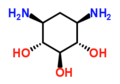 2-Deoxystreptamine
 -
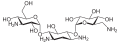 Kanamycin A
 -
 Amikacin
 -
 Tobramycin
 -
 Dibekacin
 -
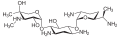 Gentamicin C2
 -
 Sisomicin
 -
 Netilmicin
 -
 Neomycin B and C
 -
 Paromomycin


Aminoglycoside[edit]
Aminoglycosides are a class of antibiotics used primarily to treat aerobic Gram-negative bacterial infections. They are derived from various species of Streptomyces and Micromonospora. Aminoglycosides are known for their bactericidal activity, which is achieved by inhibiting bacterial protein synthesis.
Mechanism of Action[edit]
Aminoglycosides exert their antibacterial effects by binding to the 30S subunit of the bacterial ribosome. This binding interferes with the initiation complex of protein synthesis, causes misreading of mRNA, and ultimately leads to the production of nonfunctional or toxic peptides. The disruption of protein synthesis is lethal to bacteria, making aminoglycosides bactericidal.
Pharmacokinetics[edit]
Aminoglycosides are not absorbed from the gastrointestinal tract, so they are usually administered intravenously or intramuscularly. They are distributed in extracellular fluid and have poor penetration into the central nervous system. Aminoglycosides are primarily excreted by the kidneys, and their half-life can be prolonged in patients with renal impairment.
Clinical Uses[edit]
Aminoglycosides are used to treat serious infections caused by aerobic Gram-negative bacteria, including Pseudomonas aeruginosa, Escherichia coli, Klebsiella pneumoniae, and Enterobacter. They are often used in combination with other antibiotics, such as beta-lactam antibiotics, to enhance their efficacy and broaden the spectrum of activity.
Adverse Effects[edit]
The use of aminoglycosides is associated with several potential adverse effects:
- Ototoxicity: Aminoglycosides can cause damage to the inner ear, leading to hearing loss and balance disturbances. This effect is often irreversible.
- Nephrotoxicity: These antibiotics can cause kidney damage, which is usually reversible upon discontinuation of the drug.
- Neuromuscular blockade: Aminoglycosides can interfere with neuromuscular transmission, potentially leading to muscle weakness and respiratory depression.
Resistance[edit]
Bacterial resistance to aminoglycosides can occur through several mechanisms:
- Enzymatic modification: Bacteria can produce enzymes that modify the aminoglycoside molecule, rendering it ineffective.
- Altered target site: Mutations in the ribosomal binding site can reduce the affinity of aminoglycosides for the ribosome.
- Efflux pumps: Some bacteria can actively pump aminoglycosides out of the cell, reducing their intracellular concentration.
Related Pages[edit]

Medical Disclaimer: WikiMD is for informational purposes only and is not a substitute for professional medical advice. Content may be inaccurate or outdated and should not be used for diagnosis or treatment. Always consult your healthcare provider for medical decisions. Verify information with trusted sources such as CDC.gov and NIH.gov. By using this site, you agree that WikiMD is not liable for any outcomes related to its content. See full disclaimer.
Credits:Most images are courtesy of Wikimedia commons, and templates, categories Wikipedia, licensed under CC BY SA or similar.
Translate page: - East Asian
中文,
日本,
한국어,
South Asian
हिन्दी,
தமிழ்,
తెలుగు,
Urdu,
ಕನ್ನಡ,
Southeast Asian
Indonesian,
Vietnamese,
Thai,
မြန်မာဘာသာ,
বাংলা
European
español,
Deutsch,
français,
Greek,
português do Brasil,
polski,
română,
русский,
Nederlands,
norsk,
svenska,
suomi,
Italian
Middle Eastern & African
عربى,
Turkish,
Persian,
Hebrew,
Afrikaans,
isiZulu,
Kiswahili,
Other
Bulgarian,
Hungarian,
Czech,
Swedish,
മലയാളം,
मराठी,
ਪੰਜਾਬੀ,
ગુજરાતી,
Portuguese,
Ukrainian

