Sarafloxacin
Sarafloxacin is a type of fluoroquinolone antibiotic that is primarily used in veterinary medicine. It is a synthetic, broad-spectrum antimicrobial agent that is bactericidal in nature. Sarafloxacin works by inhibiting the DNA gyrase and topoisomerase IV, two essential enzymes required for bacterial DNA replication, transcription, repair, and recombination.
History[edit]
Sarafloxacin was first approved by the Food and Drug Administration (FDA) in the United States in 1995 for use in poultry. However, it was voluntarily withdrawn from the market in 2001 due to concerns about the development of antibiotic resistance in humans.
Mechanism of Action[edit]
Sarafloxacin, like other fluoroquinolones, works by inhibiting the DNA gyrase and topoisomerase IV enzymes. These enzymes are necessary for the bacteria to replicate and repair their DNA. By inhibiting these enzymes, sarafloxacin prevents the bacteria from growing and multiplying, effectively killing them.
Uses[edit]
Sarafloxacin is primarily used in veterinary medicine to treat bacterial infections in animals. It was specifically approved for use in poultry to control Escherichia coli and Pasteurella multocida, two bacteria that can cause serious illness in birds.
Side Effects[edit]
As with all antibiotics, sarafloxacin can cause side effects. In animals, these can include digestive upset, such as vomiting and diarrhea, as well as skin reactions. In humans, exposure to sarafloxacin can lead to the development of antibiotic resistance.
See Also[edit]
References[edit]
 | This medical article is a stub. You can help WikiMD by expanding the page. |
-
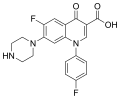 Sarafloxacin


Medical Disclaimer: WikiMD is for informational purposes only and is not a substitute for professional medical advice. Content may be inaccurate or outdated and should not be used for diagnosis or treatment. Always consult your healthcare provider for medical decisions. Verify information with trusted sources such as CDC.gov and NIH.gov. By using this site, you agree that WikiMD is not liable for any outcomes related to its content. See full disclaimer.
Credits:Most images are courtesy of Wikimedia commons, and templates, categories Wikipedia, licensed under CC BY SA or similar.
Translate page: - East Asian
中文,
日本,
한국어,
South Asian
हिन्दी,
தமிழ்,
తెలుగు,
Urdu,
ಕನ್ನಡ,
Southeast Asian
Indonesian,
Vietnamese,
Thai,
မြန်မာဘာသာ,
বাংলা
European
español,
Deutsch,
français,
Greek,
português do Brasil,
polski,
română,
русский,
Nederlands,
norsk,
svenska,
suomi,
Italian
Middle Eastern & African
عربى,
Turkish,
Persian,
Hebrew,
Afrikaans,
isiZulu,
Kiswahili,
Other
Bulgarian,
Hungarian,
Czech,
Swedish,
മലയാളം,
मराठी,
ਪੰਜਾਬੀ,
ગુજરાતી,
Portuguese,
Ukrainian

