Alanine racemase


Alanine racemase is an enzyme that catalyzes the racemization of alanine, converting the L-alanine to D-alanine and vice versa. This enzyme is crucial in the biosynthesis of D-alanine, an essential component of the bacterial cell wall.
Structure[edit]
Alanine racemase is a pyridoxal phosphate (PLP)-dependent enzyme. The enzyme typically exists as a homodimer, with each monomer containing a PLP-binding domain. The active site of alanine racemase is characterized by the presence of a lysine residue that forms a Schiff base with the PLP cofactor.

Mechanism[edit]
The mechanism of alanine racemase involves the formation of a Schiff base between the PLP cofactor and the substrate. The enzyme facilitates the removal of the _-hydrogen from L-alanine, forming a planar carbanion intermediate. This intermediate can then be reprotonated on the opposite face to form D-alanine.

Biological function[edit]
Alanine racemase plays a critical role in the synthesis of D-alanine, which is a key component of the peptidoglycan layer in bacterial cell walls. This makes the enzyme a target for antibiotic development, as inhibiting alanine racemase can disrupt cell wall synthesis and bacterial growth.
Inhibition[edit]
Inhibitors of alanine racemase are of interest as potential antibiotics. These inhibitors often mimic the transition state of the racemization reaction or bind to the PLP cofactor, preventing the enzyme from catalyzing the conversion of L-alanine to D-alanine.
Related pages[edit]
Gallery[edit]
-
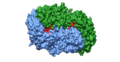 Overall structure of alanine racemase
 -
 Distance between key residues in the active site


Alanine_racemase[edit]

Medical Disclaimer: WikiMD is for informational purposes only and is not a substitute for professional medical advice. Content may be inaccurate or outdated and should not be used for diagnosis or treatment. Always consult your healthcare provider for medical decisions. Verify information with trusted sources such as CDC.gov and NIH.gov. By using this site, you agree that WikiMD is not liable for any outcomes related to its content. See full disclaimer.
Credits:Most images are courtesy of Wikimedia commons, and templates, categories Wikipedia, licensed under CC BY SA or similar.
Translate page: - East Asian
中文,
日本,
한국어,
South Asian
हिन्दी,
தமிழ்,
తెలుగు,
Urdu,
ಕನ್ನಡ,
Southeast Asian
Indonesian,
Vietnamese,
Thai,
မြန်မာဘာသာ,
বাংলা
European
español,
Deutsch,
français,
Greek,
português do Brasil,
polski,
română,
русский,
Nederlands,
norsk,
svenska,
suomi,
Italian
Middle Eastern & African
عربى,
Turkish,
Persian,
Hebrew,
Afrikaans,
isiZulu,
Kiswahili,
Other
Bulgarian,
Hungarian,
Czech,
Swedish,
മലയാളം,
मराठी,
ਪੰਜਾਬੀ,
ગુજરાતી,
Portuguese,
Ukrainian

