Ramoplanin
Ramoplanin is a lipoglycodepsipeptide antibiotic that is produced by the bacterium Actinoplanes sp. ATCC 33076. It is a potent inhibitor of bacterial cell wall synthesis and has been investigated for the treatment of Clostridium difficile infection and methicillin-resistant Staphylococcus aureus (MRSA) infections.
History[edit]
Ramoplanin was first isolated in 1984 from the fermentation broth of Actinoplanes sp. ATCC 33076. The compound was named after the RAmo group of the SAnofi pharmaceutical company, which discovered it.
Mechanism of action[edit]
Ramoplanin inhibits the final stages of peptidoglycan synthesis, which is essential for bacterial cell wall formation. It binds to the lipid intermediate Lipid II, preventing the transglycosylation and transpeptidation steps in peptidoglycan synthesis. This results in the inhibition of bacterial cell wall synthesis and ultimately leads to cell death.
Clinical use[edit]
Ramoplanin has been investigated for the treatment of infections caused by Gram-positive bacteria, including MRSA and C. difficile. It is not absorbed from the gastrointestinal tract and is therefore used for the treatment of gastrointestinal infections.
Resistance[edit]
Resistance to ramoplanin is rare. The main mechanism of resistance is the modification of the target Lipid II, which reduces the binding affinity of ramoplanin.
Safety and side effects[edit]
The most common side effects of ramoplanin are gastrointestinal disturbances, including nausea, vomiting, and diarrhea. Rare side effects include allergic reactions and changes in liver function tests.
See also[edit]
|
|
This article is a stub You can help WikiMD by registering and expanding it with useful details, internal links, formatting, and categories. Editing is available only to registered and verified users. WikiMD is a comprehensive, free health and wellness encyclopedia. |

 | This medical article is a stub. You can help WikiMD by expanding the page. |
-
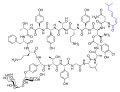 Ramoplanin
 -
 Synthesis of Hpg3-Phe9 Subunit
 -
 Fmoc-L-HAsn(Trt)-Obn Preparation
 -
 Synthesis of Depsipeptide Subunit
 -
 Synthesis of Orn10-Gly14 Subunit
 -
 Preparation of Acyl Group
 -
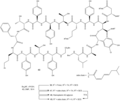 Deprotection


-Obn_Preparation.png)


Medical Disclaimer: WikiMD is for informational purposes only and is not a substitute for professional medical advice. Content may be inaccurate or outdated and should not be used for diagnosis or treatment. Always consult your healthcare provider for medical decisions. Verify information with trusted sources such as CDC.gov and NIH.gov. By using this site, you agree that WikiMD is not liable for any outcomes related to its content. See full disclaimer.
Credits:Most images are courtesy of Wikimedia commons, and templates, categories Wikipedia, licensed under CC BY SA or similar.
Translate page: - East Asian
中文,
日本,
한국어,
South Asian
हिन्दी,
தமிழ்,
తెలుగు,
Urdu,
ಕನ್ನಡ,
Southeast Asian
Indonesian,
Vietnamese,
Thai,
မြန်မာဘာသာ,
বাংলা
European
español,
Deutsch,
français,
Greek,
português do Brasil,
polski,
română,
русский,
Nederlands,
norsk,
svenska,
suomi,
Italian
Middle Eastern & African
عربى,
Turkish,
Persian,
Hebrew,
Afrikaans,
isiZulu,
Kiswahili,
Other
Bulgarian,
Hungarian,
Czech,
Swedish,
മലയാളം,
मराठी,
ਪੰਜਾਬੀ,
ગુજરાતી,
Portuguese,
Ukrainian

