Nicotine: Difference between revisions
No edit summary |
CSV import |
||
| Line 41: | Line 41: | ||
[[Category:Teratogens]] | [[Category:Teratogens]] | ||
[[Category:3-Pyridyl compounds]] | [[Category:3-Pyridyl compounds]] | ||
<gallery> | |||
File:Nikotin - Nicotine.svg|Nicotine | |||
File:Nicoderm.JPG|Nicoderm | |||
File:Side effects of nicotine.png|Side effects of nicotine | |||
File:ΔFosB accumulation.svg|ΔFosB accumulation | |||
File:NicotineDopaminergic WP1602.png|Nicotine Dopaminergic | |||
File:NicotineChromaffinCells WP1603.png|Nicotine Chromaffin Cells | |||
File:Nicotine metabolism.png|Nicotine metabolism | |||
File:Nicotine benzoate.svg|Nicotine benzoate | |||
File:Nicotine synthesis 1904.svg|Nicotine synthesis 1904 | |||
File:Nicotine biosynthesis june 2012.png|Nicotine biosynthesis June 2012 | |||
File:Joe dimaggio camel ad.jpg|Joe DiMaggio Camel ad | |||
</gallery> | |||
Latest revision as of 01:06, 20 February 2025
Information about Nicotine[edit]

Nicotine is a natural alkyloid that is a major component of cigarettes and is used therapeutically to help with smoking cessation.
Liver safety of Nicotine[edit]
Nicotine has not been associated with liver test abnormalities or with clinically apparent hepatotoxicity.
Mechanism of action of Nicotine[edit]
Nicotine (nik' oh teen) is a liquid alkyloid that has a variety of activities in the body and central nervous system (CNS), acting largely as a stimulant via activation of nicotinic receptors. Nicotine is a CNS stimulant and has both stimulatory and depressant actions on autonomic ganglia. Use of nicotine in a program to stop smoking has been shown to increase the rate of smoking cessation in oral and transdermal forms. Nicotine is readily absorbed through the skin, mucous membranes and lungs.
Brand name for Nicotine[edit]
Oral nicotine can be taken as a gum (Nicorette: 2 or 4 mg each), or lozenge (2 or 4 mg) which is dissolved in the mouth and not swallowed or chewed. Nasal spray, inhaler (Nicotrol) and transdermal formulations (NicoDerm, Habitrol and others) are also used in smoking cessation programs. Most of these products are available over the counter, without prescription.
Dosage and administration for Nicotine[edit]
The usual dose regimen varies by formulation and the dose is typically given in decreasing amounts with cigarette withdrawal. Cigarettes typically have 10 to 25 mg of nicotine each, and peak plasma nicotine levels are higher with cigarettes than with replacement products.
Side effects of Nicotine[edit]
Common side effects of nicotine include nausea, dyspepsia, nervousness, dizziness, headache, tachycardia and palpitations. Overdose of nicotine can cause mental confusion, faintness, hypotension, convulsions and respiratory failure.
Substance abuse treatment agents[edit]
- Acamprosate, Buprenorphine, Disulfiram, Methadone, Nalmefene, Naloxegol, Naloxone, Naltrexone, Nicotine, Varenicline.
| Cigarettes | ||||||||||
|---|---|---|---|---|---|---|---|---|---|---|
|
| Addiction |
| ||||||||||
|---|---|---|---|---|---|---|---|---|---|---|---|
| Dependence |
| ||||||||||
| Treatment and management |
| ||||||||||
| See also | |||||||||||

-
 Nicotine
 -
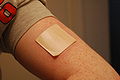 Nicoderm
 -
 Side effects of nicotine
 -
 ΔFosB accumulation
 -
 Nicotine Dopaminergic
 -
 Nicotine Chromaffin Cells
 -
Nicotine metabolism
-
 Nicotine benzoate
 -
 Nicotine synthesis 1904
 -
 Nicotine biosynthesis June 2012
 -
 Joe DiMaggio Camel ad


- Pages with broken file links
- Drugs
- Alkaloids found in Erythroxylum coca
- Alkaloids found in Nicotiana
- Anorectics
- Pfizer brands
- GSK plc brands
- Anxiolytics
- Euphoriants
- Nicotinic agonists
- Nicotinic antagonists
- Plant toxin insecticides
- Pregnane X receptor agonists
- Pyridine alkaloids
- Pyrrolidine alkaloids
- Smoking
- Stimulants
- Teratogens
- 3-Pyridyl compounds

