Parkinson's disease

Editor-In-Chief: Prab R Tumpati, MD
Obesity, Sleep & Internal medicine
Founder, WikiMD Wellnesspedia &
W8MD's weight loss doctor NYC
Philadelphia GLP-1 weight loss and GLP-1 clinic NYC
| Parkinson's disease | |
|---|---|
.png)
| |
| Synonyms | N/A |
| Pronounce | N/A |
| Specialty | N/A |
| Symptoms | Tremor, rigidity, bradykinesia, postural instability |
| Complications | N/A |
| Onset | Typically after age 60 |
| Duration | Long term |
| Types | N/A |
| Causes | Unknown, believed to involve genetics and environmental factors |
| Risks | Ageing, family history, male gender |
| Diagnosis | Based on medical history and neurological examination |
| Differential diagnosis | Essential tremor, dementia with Lewy bodies, multiple system atrophy |
| Prevention | N/A |
| Treatment | Levodopa, dopamine agonists, deep brain stimulation |
| Medication | N/A |
| Prognosis | Progressive, with variable rate of progression |
| Frequency | 6.1 million globally (2016) |
| Deaths | N/A |
Parkinson's disease (PD) is a long-term degenerative disorder of the central nervous system. Its main effects are on the motor system, but as the disease progresses, non-motor symptoms become common. Although the exact cause is unknown, both genetic and environmental factors are believed to play a role.


Classification[edit]
PD is primarily classified as a movement disorder. It falls under the broader category of Parkinsonian syndromes, which comprises disorders exhibiting similar symptoms but with distinct causes.

Signs and Symptoms[edit]

Motor[edit]
- Tremor: Often starts in a limb, especially the hand or fingers. This is sometimes referred to as "resting tremor."
- Bradykinesia: The slowing down and loss of spontaneous and automatic movement.
- Rigidity: Muscle stiffness that occurs in any part of the body.
- Postural instability: Balance problems, leading to falls.
Neuropsychiatric[edit]
- Cognitive decline: Including slowed thinking, difficulties with reasoning, and memory issues.
- Mood disorders: Such as depression and anxiety.
- Apathy: A general lack of enthusiasm or motivation.
- Hallucinations and Delusions: Particularly visual hallucinations.
Other[edit]
- Sleep disturbances and disorders
- Speech changes and difficulties
- Problems with swallowing
- Constipation
- Urinary problems
- Reduced or loss of sense of smell
Causes[edit]
Environmental Factors[edit]
- Exposure to certain toxins and chemicals, notably pesticides, has been linked with a heightened risk of developing PD.
- Head injuries and trauma have also been considered potential risk factors.
Genetics[edit]
While the majority of PD cases are idiopathic (of unknown cause), certain genetic mutations have been identified that can increase the risk, especially in familial cases of PD.
Pathophysiology[edit]
Brain Cell Death[edit]
The primary pathological characteristic of PD is the loss of dopamine-producing neurons in the substantia nigra. This loss leads to a deficiency of the neurotransmitter dopamine, critical for coordinating smooth and balanced muscle movement.
Diagnosis[edit]


Imaging[edit]
Neuroimaging techniques, such as MRI and PET scans, can help rule out other disorders but are not diagnostic for PD.
Differential Diagnosis[edit]
Conditions such as multiple system atrophy, progressive supranuclear palsy, and drug-induced parkinsonism can produce symptoms similar to PD.
Prevention[edit]
Currently, there's no sure way to prevent PD. However, some data suggest that caffeine consumption, regular aerobic exercise, and avoidance of certain environmental toxins might reduce the risk.
Management[edit]
Medications[edit]
- Levodopa (often combined with carbidopa)
- Dopamine agonists
- MAO-B inhibitors
- Anticholinergics
Surgery[edit]
Deep brain stimulation (DBS) is the primary surgical treatment, especially for patients who no longer respond adequately to medications.
Rehabilitation[edit]
Physical, occupational, and speech therapies can all be beneficial for PD patients to manage their symptoms better.
Palliative Care[edit]
This form of care is aimed at improving the overall quality of life for patients with advanced PD and their families.
Prognosis[edit]
PD is a progressive disorder, with symptoms typically worsening over time.
Epidemiology[edit]
PD is most commonly diagnosed in individuals over the age of 60. The incidence is slightly higher in men than in women.
History[edit]
PD is named after the English doctor James Parkinson, who published the first detailed description in An Essay on the Shaking Palsy in 1817.
Society and Culture[edit]
Cost[edit]
The financial burden of PD is significant, encompassing medical and non-medical expenses. Direct costs include hospitalizations, doctor visits, and medications, while indirect costs might involve lost wages, early retirement, or modifications to a home.
Advocacy[edit]
Numerous organizations around the world, like the Parkinson's Foundation and Michael J. Fox Foundation, advocate for better research, care, and awareness of PD. These bodies often lead initiatives for fundraising, support groups, and educational events.
Notable Cases[edit]
- Muhammad Ali, the renowned boxer, was diagnosed with Parkinson's in 1984.
- Actor Michael J. Fox was diagnosed with early-onset Parkinson's in 1991 and has since become a significant advocate for research and awareness.
Research[edit]
Animal Models[edit]
Several animal models, particularly rodents and primates, have been developed to study PD. They help in understanding the disease progression and in testing potential treatments.
Gene Therapy[edit]
Gene therapy aims to replace or augment the function of an aberrant gene or to modulate the expression of a gene. In the context of PD, research is ongoing to assess the viability of this approach.
Neuroprotective Treatments[edit]
Researchers are exploring drugs that could protect dopamine-producing neurons from damage, potentially halting the progression of the disease.
Cell-Based Therapies[edit]
Stem cells and other cell-based therapies are being investigated for their potential to replace lost neurons in PD patients.
Epidemiology[edit]
PD is a global disease, affecting all ethnicities and cultures. Its prevalence increases with age, and as global populations grow older, the number of PD cases is expected to rise.
History[edit]
Beyond James Parkinson's initial discovery, there's a long history of research and discoveries in the realm of PD. The 20th century saw significant advancements in understanding the disease's biochemistry and introducing levodopa as a treatment.
-
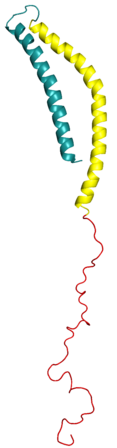 The protein alpha-synuclein aggregates into Lewy bodies and neurites
 -
 The protein alpha-synuclein aggregates into Lewy bodies and neurites
 -
 Environmental toxicants like pesticides are believed to be a trigger for Parkinson's
 -
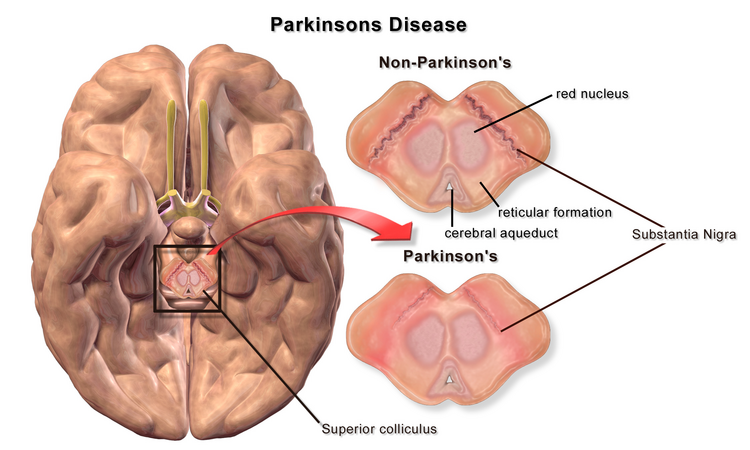 Parkinson's results from the death of dopamine-releasing neurons in the substantia nigra pars compacta
 -
 Lewy bodies and Lewy neurites stained brown in PD brain tissue
 -
 Reduced radioisotopic F-DOPA uptake in the striatum of a Parkinson's patient, captured through PET
 -
 The "Hot Cross Bun" sign, found in multiple system atrophy with MRI
 -
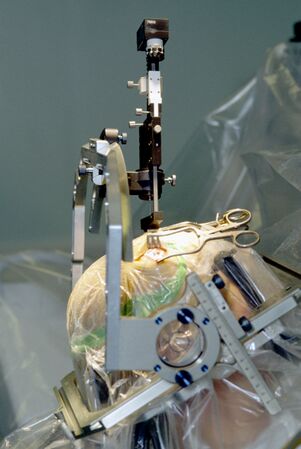 Placement of an electrode into the brain for deep brain stimulation
 -
 Exercise, like the tricycle ride of this PD patient, is often recommended
 -
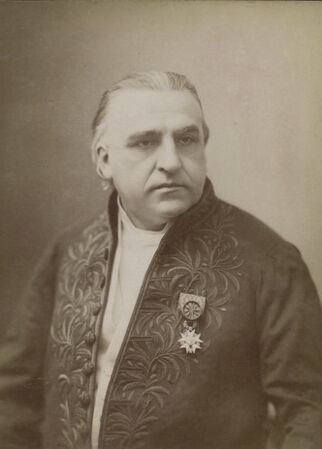 In 1877, Jean-Martin Charcot named the disease for James Parkinson
 -
 The Internal Classic (Circa 425–221 BC), a Chinese text credited to the Yellow Emperor, details a disease with strikingly parkinsonian symptoms
 -
 Astronaut Alexander Gerst conducts Parkinson's research aboard the International Space Station in 2018
 -
 Actor Michael J. Fox and boxer Muhammad Ali are pictured in 2002 speaking before the US Senate to urge increased funding for Parkinson's research

_1.jpg)


.jpg)


.jpg)


This WikiMD article can only be edited by registered and verified editors. You can log in or register.
| Diseases of the nervous system, primarily CNS (G04–G47, 323–349) | ||||||||||||||||||||
|---|---|---|---|---|---|---|---|---|---|---|---|---|---|---|---|---|---|---|---|---|
|
| Antiparkinson agents (N04) | ||||||||||||||||||
|---|---|---|---|---|---|---|---|---|---|---|---|---|---|---|---|---|---|---|
|

Medical Disclaimer: WikiMD is for informational purposes only and is not a substitute for professional medical advice. Content may be inaccurate or outdated and should not be used for diagnosis or treatment. Always consult your healthcare provider for medical decisions. Verify information with trusted sources such as CDC.gov and NIH.gov. By using this site, you agree that WikiMD is not liable for any outcomes related to its content. See full disclaimer.
Credits:Most images are courtesy of Wikimedia commons, and templates, categories Wikipedia, licensed under CC BY SA or similar.
Translate page: - East Asian
中文,
日本,
한국어,
South Asian
हिन्दी,
தமிழ்,
తెలుగు,
Urdu,
ಕನ್ನಡ,
Southeast Asian
Indonesian,
Vietnamese,
Thai,
မြန်မာဘာသာ,
বাংলা
European
español,
Deutsch,
français,
Greek,
português do Brasil,
polski,
română,
русский,
Nederlands,
norsk,
svenska,
suomi,
Italian
Middle Eastern & African
عربى,
Turkish,
Persian,
Hebrew,
Afrikaans,
isiZulu,
Kiswahili,
Other
Bulgarian,
Hungarian,
Czech,
Swedish,
മലയാളം,
मराठी,
ਪੰਜਾਬੀ,
ગુજરાતી,
Portuguese,
Ukrainian

