Intrauterine device
Intrauterine Device (IUD)

This medical device related article is a stub.
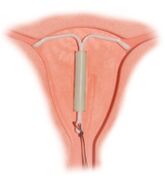
An intrauterine device (IUD) is a small, T-shaped contraceptive device that is inserted into a woman's uterus to prevent pregnancy. It is a long-term, reversible form of birth control and is considered one of the most effective contraceptive methods available.

Types of IUDs[edit]
There are two primary types of IUDs:
- Copper IUDs – Such as ParaGard, which releases copper ions that create an inhospitable environment for sperm, preventing fertilization. Copper IUDs can also be used as emergency contraception if inserted within five days of unprotected sex.
- Hormonal IUDs – Include Mirena, Kyleena, Liletta, and Skyla. These IUDs release progestin, a synthetic form of the hormone progesterone, which thickens cervical mucus to block sperm and sometimes suppresses ovulation.
Mechanism of Action[edit]
IUDs work primarily by:
- Preventing fertilization by altering the uterine and cervical environment
- Thickening cervical mucus (hormonal IUDs), making it difficult for sperm to reach the egg
- Preventing implantation in the uterus through inflammatory changes in the endometrial lining
- Acting as a spermicide (copper IUDs), making sperm inactive
Effectiveness[edit]
IUDs are over 99% effective, meaning fewer than 1 in 100 women using an IUD will become pregnant each year. Once inserted, they provide long-lasting protection:
- Copper IUDs – Effective for up to 10 years
- Hormonal IUDs – Last between 3 to 7 years, depending on the brand
Insertion and Removal[edit]
Insertion The IUD is inserted into the uterus by a healthcare provider, typically during an office visit. The procedure takes a few minutes and may cause mild to moderate discomfort. Some providers recommend taking pain relievers beforehand to ease cramping.
Removal IUDs can be removed at any time by a healthcare provider. Fertility typically returns quickly after removal.
Advantages[edit]
- Long-term protection – Lasts several years depending on the type
- Reversible – Fertility returns soon after removal
- No daily maintenance – Unlike oral contraceptives, IUDs require no daily adherence
- Highly effective – Low failure rate compared to other contraceptive methods
- Can be used by breastfeeding women – Does not affect milk production
Side Effects and Risks[edit]
While IUDs are generally safe, they may cause:
- Irregular bleeding or spotting (especially in the first few months)
- Cramping and discomfort after insertion
- Expulsion – In rare cases, the IUD may slip out of place
- Perforation – In very rare instances, the IUD may puncture the uterine wall
- Increased menstrual bleeding and cramping (more common with copper IUDs)
Contraindications[edit]
IUDs may not be recommended for individuals with:
- Active pelvic infections (such as untreated sexually transmitted infections)
- Abnormal uterine shape or fibroids that distort the uterine cavity
- Unexplained vaginal bleeding
- History of uterine perforation
- Copper allergy (for copper IUDs)
History of IUDs[edit]
The concept of intrauterine contraception dates back to ancient times, but modern IUDs have been in use since the early 1900s:
- The first widely used IUD was the Grafenberg ring, developed in the 1920s.
- The Dalkon Shield, a now-defunct IUD from the 1970s, led to controversy due to safety concerns.
- Modern IUDs, introduced in the 1980s and beyond, are safer, more effective, and widely recommended for contraception.
IUDs and Emergency Contraception[edit]
The copper IUD is one of the most effective forms of emergency contraception, reducing the risk of pregnancy by more than 99% when inserted within five days of unprotected intercourse.
Comparisons with Other Birth Control Methods[edit]
Comparisons with Other Birth Control Methods[edit]
| Method | Effectiveness | Duration | Hormonal |
|---|---|---|---|
| IUD (hormonal) | 99% | 3-7 years | Yes |
| IUD (copper) | 99% | Up to 10 years | No |
| Birth control pill | 91% | Daily | Yes |
| Condoms | 85% | Single-use | No |
| Implant | 99% | Up to 5 years | Yes |
Common Myths About IUDs[edit]
- 1. "IUDs cause infertility."
- FALSE: IUDs do not cause infertility. Fertility returns quickly after removal.
- 2. "IUDs are only for women who have had children."
- FALSE: IUDs are safe for both women who have had children and those who have not.
- 3. "IUDs can travel to the heart or brain."
- FALSE: IUDs stay within the uterus and do not migrate to other body parts.
- 4. "IUD insertion is extremely painful."
- FALSE: While some discomfort is normal, most people tolerate the procedure well.
See Also[edit]
| Birth control methods | ||||||||||
|---|---|---|---|---|---|---|---|---|---|---|
|
| Active molecules in hormonal contraceptives | ||||||||||||||||||
|---|---|---|---|---|---|---|---|---|---|---|---|---|---|---|---|---|---|---|
|
| Routes of administration, dosage forms | ||||||||||
|---|---|---|---|---|---|---|---|---|---|---|
|


 Women's health Women's health |
||||||||||
|---|---|---|---|---|---|---|---|---|---|---|
|
| Female reproductive system | ||||||||||||||||||||
|---|---|---|---|---|---|---|---|---|---|---|---|---|---|---|---|---|---|---|---|---|
|

Sponsored Health Resource

W8MD Weight Loss, Sleep & MedSpa
Looking for physician-supervised weight loss, semaglutide, tirzepatide, or GLP-1 receptor agonist options? W8MD helps eligible patients in New York City, Brooklyn, New Jersey, Connecticut, Pennsylvania, Delaware, and greater Philadelphia with medical weight loss, sleep medicine, and long-term maintenance support.
GLP-1 specials: Affordable GLP-1 injections NYC and Philadelphia starting from $29.99/week and up for semaglutide with insurance accepted for qualifying visits, and $45/week and up for tirzepatide with insurance accepted for qualifying visits. Self-pay options start from $59.99/week and up for semaglutide and $69.99/week and up for tirzepatide.
Medical weight loss NYC | Affordable GLP-1 injections NYC | Budget GLP-1 weight loss shots Philadelphia | New Jersey medical weight loss | NYC medical weight loss | Philadelphia medical weight loss | Sleep clinic NYC | W8MD's Philadelphia GLP-1 doctor | Weight loss prescriptions NYC
Book a W8MD appointment · View GLP-1 specials
Paid promotional message. Eligibility, pricing, insurance coverage, medication availability, and results vary. Medical evaluation required.

Medical Disclaimer: WikiMD is for informational purposes only and is not a substitute for professional medical advice. Content may be inaccurate or outdated and should not be used for diagnosis or treatment. Always consult your healthcare provider for medical decisions. Verify information with trusted sources such as CDC.gov and NIH.gov. By using this site, you agree that WikiMD is not liable for any outcomes related to its content. See full disclaimer.
Credits:Most images are courtesy of Wikimedia commons, and templates, categories Wikipedia, licensed under CC BY SA or similar.
Translate page: - East Asian
中文,
日本,
한국어,
South Asian
हिन्दी,
தமிழ்,
తెలుగు,
Urdu,
ಕನ್ನಡ,
Southeast Asian
Indonesian,
Vietnamese,
Thai,
မြန်မာဘာသာ,
বাংলা
European
español,
Deutsch,
français,
Greek,
português do Brasil,
polski,
română,
русский,
Nederlands,
norsk,
svenska,
suomi,
Italian
Middle Eastern & African
عربى,
Turkish,
Persian,
Hebrew,
Afrikaans,
isiZulu,
Kiswahili,
Other
Bulgarian,
Hungarian,
Czech,
Swedish,
മലയാളം,
मराठी,
ਪੰਜਾਬੀ,
ગુજરાતી,
Portuguese,
Ukrainian

