Host–guest chemistry


Host–guest chemistry is a branch of supramolecular chemistry that focuses on the interaction between two or more molecules or ions that do not share covalent bonds but instead form complexes based on non-covalent interactions. These interactions include hydrogen bonding, metal coordination, hydrophobic forces, van der Waals forces, π-π interactions, and electrostatic effects. The molecules or ions involved in host–guest chemistry are typically classified into two categories: the "host" and the "guest." The host is usually a larger molecule or molecular assembly that provides a cavity or framework within which the guest, a smaller molecule or ion, can reside. This field of chemistry is fundamental in understanding biological processes and has applications in areas such as drug delivery, molecular sensing, and the design of new materials.
Overview[edit]
Host–guest chemistry involves the selective interaction of two or more species through non-covalent bonding. The host molecule is designed to have a specific shape, size, and functional groups that complement the guest molecule, allowing for a selective and often reversible association. This specificity and reversibility are key features that distinguish host–guest systems from other chemical complexes.
Types of Host–Guest Systems[edit]
There are several types of host-guest systems, categorized based on the nature of the host and the guest. Common examples include:
- Cyclodextrins: These are cyclic oligosaccharides that form a toroidal shape with a hydrophobic interior. They are capable of encapsulating hydrophobic molecules in aqueous solutions, making them useful in pharmaceutical applications.
- Crown ethers: These are cyclic compounds that can selectively bind certain cations, such as potassium or sodium, within their ring structure through electrostatic interactions and coordination.
- Calixarenes: These are macrocyclic compounds that can act as hosts for various ions and small molecules, utilizing hydrophobic, hydrophilic, and ion-dipole interactions.
- Cryptands: These are bicyclic or polycyclic compounds that can encapsulate ions within their structure, providing a highly selective and strong binding.
Applications[edit]
Host–guest chemistry has a wide range of applications in various fields:
- Drug Delivery: Host molecules can encapsulate pharmaceutical compounds, improving their solubility, stability, and bioavailability.
- Sensing and Detection: Host–guest interactions can be used to develop sensors for detecting specific molecules or ions with high selectivity and sensitivity.
- Material Science: The principles of host–guest chemistry are applied in the design of novel materials with specific properties, such as stimuli-responsive polymers.
- Environmental Remediation: Host molecules can capture pollutants or toxic substances, facilitating their removal from the environment.
Challenges and Future Directions[edit]
While host–guest chemistry offers promising applications, there are challenges to be addressed, such as improving the selectivity and stability of host–guest complexes and developing methods for the large-scale synthesis of host molecules. Future research in this field is likely to focus on the design of more sophisticated host systems, exploring their potential in nanotechnology, and expanding their applications in medicine and environmental science.
Images[edit]
-
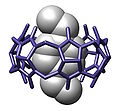 Uril ActaCrystall Ball Structure
 -
 Host–guest chemistry encapsulating assembly
 -
 Host–guest chemistry
 -
 Nitrobenzene bound within hemicarcerand
 -
 Host–guest chemistry


2CCl4.jpg)
.jpg)


Medical Disclaimer: WikiMD is for informational purposes only and is not a substitute for professional medical advice. Content may be inaccurate or outdated and should not be used for diagnosis or treatment. Always consult your healthcare provider for medical decisions. Verify information with trusted sources such as CDC.gov and NIH.gov. By using this site, you agree that WikiMD is not liable for any outcomes related to its content. See full disclaimer.
Credits:Most images are courtesy of Wikimedia commons, and templates, categories Wikipedia, licensed under CC BY SA or similar.
Translate page: - East Asian
中文,
日本,
한국어,
South Asian
हिन्दी,
தமிழ்,
తెలుగు,
Urdu,
ಕನ್ನಡ,
Southeast Asian
Indonesian,
Vietnamese,
Thai,
မြန်မာဘာသာ,
বাংলা
European
español,
Deutsch,
français,
Greek,
português do Brasil,
polski,
română,
русский,
Nederlands,
norsk,
svenska,
suomi,
Italian
Middle Eastern & African
عربى,
Turkish,
Persian,
Hebrew,
Afrikaans,
isiZulu,
Kiswahili,
Other
Bulgarian,
Hungarian,
Czech,
Swedish,
മലയാളം,
मराठी,
ਪੰਜਾਬੀ,
ગુજરાતી,
Portuguese,
Ukrainian

