Fertility awareness
Fertility awareness or natural family planning is a method of understanding the reproductive cycle to predict when a woman is most likely to get pregnant. It is done by observing changes in a woman's body and menstrual cycle.
Overview[edit]
Fertility awareness is used both as a means of preventing pregnancy and as a way to target the most fertile time for getting pregnant. It involves tracking the length of the menstrual cycle, observing changes in cervical mucus, and taking body temperature each day to estimate ovulation.
Methods[edit]
There are several methods of fertility awareness:
- Basal body temperature method: This involves taking your temperature every morning before any activity. A slight increase in temperature can indicate ovulation.
- Cervical mucus method: This involves observing changes in the cervical mucus throughout the menstrual cycle. The mucus changes in color, consistency, and volume at different times in the cycle.
- Symptothermal method: This method combines both the basal body temperature and cervical mucus methods, along with other signs of fertility, to predict ovulation.
Effectiveness[edit]
The effectiveness of fertility awareness for birth control varies, depending on the method used and how accurately it is followed. It is estimated to be about 76-88% effective.
Risks[edit]
Fertility awareness does not protect against sexually transmitted infections (STIs). In addition, there is a risk of unintended pregnancy if the methods are not used correctly.
See also[edit]
References[edit]

This WikiMD article can only be edited by registered and verified editors. You can log in or register.
-
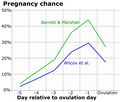 Fertility awareness


Medical Disclaimer: WikiMD is for informational purposes only and is not a substitute for professional medical advice. Content may be inaccurate or outdated and should not be used for diagnosis or treatment. Always consult your healthcare provider for medical decisions. Verify information with trusted sources such as CDC.gov and NIH.gov. By using this site, you agree that WikiMD is not liable for any outcomes related to its content. See full disclaimer.
Credits:Most images are courtesy of Wikimedia commons, and templates, categories Wikipedia, licensed under CC BY SA or similar.
Translate page: - East Asian
中文,
日本,
한국어,
South Asian
हिन्दी,
தமிழ்,
తెలుగు,
Urdu,
ಕನ್ನಡ,
Southeast Asian
Indonesian,
Vietnamese,
Thai,
မြန်မာဘာသာ,
বাংলা
European
español,
Deutsch,
français,
Greek,
português do Brasil,
polski,
română,
русский,
Nederlands,
norsk,
svenska,
suomi,
Italian
Middle Eastern & African
عربى,
Turkish,
Persian,
Hebrew,
Afrikaans,
isiZulu,
Kiswahili,
Other
Bulgarian,
Hungarian,
Czech,
Swedish,
മലയാളം,
मराठी,
ਪੰਜਾਬੀ,
ગુજરાતી,
Portuguese,
Ukrainian

