Levonorgestrel
Levonorgestrel is a synthetically derived progestin used primarily in emergency contraception and standard oral contraceptives. It acts as an agonist of the progesterone receptor, providing effective contraception by preventing ovulation.

Pharmacological Profile[edit]
Levonorgestrel operates as an emergency contraceptive by hindering the luteinizing hormone (LH) surge that precedes ovulation. Its efficiency is observed predominantly when administered before this LH surge, and it demonstrates minimal effects on fertilization or implantation.
Clinical Efficacy[edit]
Clinical studies have evidenced the efficacy of levonorgestrel in significantly lowering the rate of unwanted pregnancies when used within 48 hours of unprotected intercourse or suspected contraceptive failure. The overall failure rates range from 0.6% to 3.1%, compared to expected rates of 5% to 6%.
Approval and Usage[edit]
The United States Food and Drug Administration (FDA) approved levonorgestrel for emergency contraception use in 1982. Available generically and over-the-counter, it is administered in tablet form in doses of 0.75 and 1.5 mg. The recommended regimen for emergency contraception is a total dose of 1.5 mg, taken within 72 hours of unprotected intercourse or suspected contraceptive failure.
Levonorgestrel also serves as a constituent of standard oral contraceptives, where it is used alone or in combination with estrogens.
Safety Profile[edit]
The use of levonorgestrel has not been associated with liver enzyme elevations or clinically apparent liver injury with jaundice.
Adverse Effects[edit]
Potential side effects of levonorgestrel use, generally mild-to-moderate in severity, can include headache, nausea, abdominal pain, dysmenorrhea, breast tenderness, fatigue, and dizziness.
Obstetrical and Gynecological Agents[edit]
- Pregnancy termination agents
- Progesterone and the Progestins
-
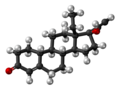 Levonorgestrel

Sponsored Health Resource

W8MD Weight Loss, Sleep & MedSpa
Looking for physician-supervised weight loss, semaglutide, tirzepatide, or GLP-1 receptor agonist options? W8MD helps eligible patients in New York City, Brooklyn, New Jersey, Connecticut, Pennsylvania, Delaware, and greater Philadelphia with medical weight loss, sleep medicine, and long-term maintenance support.
GLP-1 specials: Affordable GLP-1 injections NYC and Philadelphia starting from $29.99/week and up for semaglutide with insurance accepted for qualifying visits, and $45/week and up for tirzepatide with insurance accepted for qualifying visits. Self-pay options start from $59.99/week and up for semaglutide and $69.99/week and up for tirzepatide.
- Medical weight loss NYC
- Affordable GLP-1 injections NYC
- Budget GLP-1 weight loss shots Philadelphia
- New Jersey medical weight loss
- NYC medical weight loss blog
- Philadelphia weight loss blog
- Sleep medicine and sleep apnea services
- W8MD MedSpa and wellness
Book a W8MD appointment · View GLP-1 specials
Paid promotional message. Eligibility, pricing, insurance coverage, medication availability, and results vary. Medical evaluation required.

Medical Disclaimer: WikiMD is for informational purposes only and is not a substitute for professional medical advice. Content may be inaccurate or outdated and should not be used for diagnosis or treatment. Always consult your healthcare provider for medical decisions. Verify information with trusted sources such as CDC.gov and NIH.gov. By using this site, you agree that WikiMD is not liable for any outcomes related to its content. See full disclaimer.
Credits:Most images are courtesy of Wikimedia commons, and templates, categories Wikipedia, licensed under CC BY SA or similar.
Translate page: - East Asian
中文,
日本,
한국어,
South Asian
हिन्दी,
தமிழ்,
తెలుగు,
Urdu,
ಕನ್ನಡ,
Southeast Asian
Indonesian,
Vietnamese,
Thai,
မြန်မာဘာသာ,
বাংলা
European
español,
Deutsch,
français,
Greek,
português do Brasil,
polski,
română,
русский,
Nederlands,
norsk,
svenska,
suomi,
Italian
Middle Eastern & African
عربى,
Turkish,
Persian,
Hebrew,
Afrikaans,
isiZulu,
Kiswahili,
Other
Bulgarian,
Hungarian,
Czech,
Swedish,
മലയാളം,
मराठी,
ਪੰਜਾਬੀ,
ગુજરાતી,
Portuguese,
Ukrainian

