Opium: Difference between revisions
No edit summary |
No edit summary |
||
| Line 1: | Line 1: | ||
Opium and heroin are two potent opiates with rich histories and significant societal impacts. While they possess recognized medicinal properties, both substances have gained infamy due to their strong potential for misuse and the associated health implications. | {{Infobox botanical product | ||
[[File:Papaversomniferum.jpg|thumb|Papaversomniferum]] | |image = Opium pod cut to demonstrate fluid extraction1.jpg | ||
|caption = Opium poppy seed pod exuding latex from a cut | |||
|product = Opium, opium gum, opium resin. | |||
|plant = ''[[Papaver somniferum]]'' | |||
|part = [[Latex]] [[Capsule (fruit)|capsule]] [[seeds]] | |||
|origin = Uncertain, possibly Asia Minor | |||
|active = {{flatlist| | |||
* [[Morphine]] | |||
* [[codeine]] | |||
* [[noscapine]] | |||
* [[papaverine]] | |||
* [[thebaine]] | |||
}} | |||
|producers = {{flatlist| | |||
* [[Myanmar]] | |||
* [[Afghanistan]] | |||
* [[Colombia]] | |||
* [[Laos]] | |||
* [[Mexico]] | |||
* [[India]] | |||
* [[Pakistan]] | |||
* [[Thailand]] | |||
* [[Turkey]] | |||
* [[China]] | |||
* [[Australia]] | |||
}} | |||
|consumers = Worldwide (#1: Iran) | |||
|wholesale = | |||
|retail = | |||
|legal_AU = S8 | |||
|legal_BR = A1 | |||
|legal_CA = Schedule I | |||
| legal_DE = Anlage III | |||
| legal_NZ = Class B | |||
|legal_UK = Class A | |||
|legal_US = Schedule II | |||
|legal_UN = Narcotic Schedule I | |||
|legal_status = Controlled unless and except for medical use under a license. | |||
}} | |||
Opium and [[heroin]] are two potent opiates with rich histories and significant societal impacts. While they possess recognized medicinal properties, both substances have gained infamy due to their strong potential for misuse and the associated health implications. | |||
[[File:Papaversomniferum.jpg|thumb|Papaversomniferum]] | |||
Both heroin and opium are classified as [[drugs of abuse]] and are prohibited in many countries, including the United States. Their complex histories intertwine with medicinal use, recreational abuse, and significant sociopolitical events worldwide. | Both heroin and opium are classified as [[drugs of abuse]] and are prohibited in many countries, including the United States. Their complex histories intertwine with medicinal use, recreational abuse, and significant sociopolitical events worldwide. | ||
=== Opium === | |||
[[File:Raw opium.jpg|Raw opium|thumb]] | [[File:Raw opium.jpg|Raw opium|thumb]] | ||
Opium (o pee’ um) is an amalgamation of natural alkaloids extracted from the resin of the seeds of the '''opium poppy, Papaver somniferum'''. Recognized for its analgesic and mood-modifying properties, the use of poppy extracts spans several centuries. Its influence on global history and individual lives is profound. | Opium (o pee’ um) is an amalgamation of natural alkaloids extracted from the resin of the seeds of the '''opium poppy, Papaver somniferum'''. Recognized for its analgesic and mood-modifying properties, the use of poppy extracts spans several centuries. Its influence on global history and individual lives is profound. | ||
=== Heroin === | |||
[[File:Malwapoppy.jpg|thumb|Malwapoppy]] | [[File:Malwapoppy.jpg|thumb|Malwapoppy]] | ||
Heroin, chemically known as morphine diacetate, emerged in the 19th century as a byproduct of morphine, opium's primary alkaloid. Originally believed to offer strong pain-relieving properties minus the characteristic [[euphoria]] and [[dependency]] risks of opium, it was initially marketed as an over-the-counter cough suppressant under the brand name "Heroin." Its potential for abuse quickly became evident, and by the 1920s, heroin became the predominant drug of abuse in the U.S., culminating in its prohibition. | Heroin, chemically known as morphine diacetate, emerged in the 19th century as a byproduct of morphine, opium's primary alkaloid. Originally believed to offer strong pain-relieving properties minus the characteristic [[euphoria]] and [[dependency]] risks of opium, it was initially marketed as an over-the-counter cough suppressant under the brand name "Heroin." Its potential for abuse quickly became evident, and by the 1920s, heroin became the predominant drug of abuse in the U.S., culminating in its prohibition. | ||
| Line 21: | Line 60: | ||
Both substances predominantly act as agonists for opiate receptors, chiefly the µ type receptor. These receptors are primarily found in the central nervous system but are also present in other parts of the body, including the lungs, heart, gastrointestinal tract, and even circulating white blood cells. | Both substances predominantly act as agonists for opiate receptors, chiefly the µ type receptor. These receptors are primarily found in the central nervous system but are also present in other parts of the body, including the lungs, heart, gastrointestinal tract, and even circulating white blood cells. | ||
=== Clinical Effects === | |||
Opium and heroin induce various clinical effects, with the most noticeable being: | Opium and heroin induce various clinical effects, with the most noticeable being: | ||
| Line 33: | Line 72: | ||
== Summary == | == Summary == | ||
While opium and heroin have undeniable therapeutic potential, their misuse and associated risks have led to their prohibition in many countries. Their role in societal and health contexts remains a topic of debate and study. | While opium and heroin have undeniable therapeutic potential, their misuse and associated risks have led to their prohibition in many countries. Their role in societal and health contexts remains a topic of debate and study. | ||
[[ | <gallery> | ||
[[ | <gallery> | ||
[[ | File:10 peintures annamites représentant les métiers au Tonkin (Fumeurs d'opium Annam - Tonkin).jpg|Two men smoking opium in [[Tonkin (French protectorate)|Tonkin]] in 1923 | ||
[[ | File:A busy stacking room in the opium factory at Patna, India. L Wellcome V0019154.jpg|Storage of opium at a [[British East India Company]] warehouse | ||
{{ | File:Afghanistan opium poppy cultivation 1994-2007b.PNG|Afghanistan opium poppy cultivation, 1994–2016 (hectares) | ||
{{ | File:Akha man with opium pipe.jpg|An [[Akha people|Akha]] man smokes a pipe containing opium mixed with tobacco. | ||
File:Apothecary vessel Opium 18-19 century.jpg|Apothecary vessel for storage of opium as a pharmaceutical, Germany, 18th or 19th century | |||
File:British ships in Canton.jpg|British assault on [[Guangzhou|Canton]] during the [[First Opium War]], May 1841 | |||
File:Canons of medicine.JPG|Latin translation of [[Avicenna]]'s ''Canon of Medicine'', 1483 | |||
File:Cover page of The Truth About Opium Smoking (1882).jpg|The cover page of the book of The Truth about Opium Smoking | |||
File:Destruction of opium in 1839.jpg|[[Destruction of opium at Humen]], June 1839 | |||
File:Drugroutemap.gif|International drug routes | |||
File:Harvesting opium.jpg|Harvesting opium | |||
File:Malwapoppy.jpg|Poppy crop from the [[Malwa]] in India | |||
File:Morphine10mgmLvial.jpg|Modern vial of morphine first isolated from opium by Friedrich Sertürner | |||
File:Opium (Drug).jpg|Dried latex from opium poppy | |||
File:Opium poppies in Helmand -a.jpg|Afghanistan, [[Helmand province]]. A [[United States Marines|Marine]] greets local children working in the field of opium poppies near the base. | |||
File:Opium smokers China.gif|A Chinese opium house; photographed in 1902 | |||
File:The Opium Seller (W. Müller).jpg|An artist's view of an Ottoman opium seller | |||
File:William John Huggins - The opium ships at Lintin, China, 1824.jpg|British opium ships | |||
File:opiumball.jpg|Spanish opium ball | |||
File:Опиумоеды.jpg|''Opium-eaters'' by [[Vasily Vereshchagin]] depicts an opium den in [[Turkestan]], 1868 | |||
File:中國人服食鴉片圖.PNG|An opium den in 18th-century China. | |||
</gallery> | |||
{{Ancient anaesthesia-footer}} | |||
{{Opioidergics}} | |||
[[Category:Euphoriants]] | |||
[[Category:IARC Group 1 carcinogens]] | |||
[[Category:Medicinal plants]] | |||
[[Category:Morphine]] | |||
[[Category:Opioids]] | |||
[[Category:Opium| ]] | |||
{{nt}} | |||
Revision as of 00:25, 16 January 2025
| Botanical Product | |
|---|---|

| |
| Opium poppy seed pod exuding latex from a cut | |
| Scientific name | |
| Family | |
| Origin | Uncertain, possibly Asia Minor |
| Part used | |
| Main constituents | |
| Common uses | |
| Other names | |
| This is a summary of botanical information. | |
Opium and heroin are two potent opiates with rich histories and significant societal impacts. While they possess recognized medicinal properties, both substances have gained infamy due to their strong potential for misuse and the associated health implications.

Both heroin and opium are classified as drugs of abuse and are prohibited in many countries, including the United States. Their complex histories intertwine with medicinal use, recreational abuse, and significant sociopolitical events worldwide.
Opium

Opium (o pee’ um) is an amalgamation of natural alkaloids extracted from the resin of the seeds of the opium poppy, Papaver somniferum. Recognized for its analgesic and mood-modifying properties, the use of poppy extracts spans several centuries. Its influence on global history and individual lives is profound.
Heroin

Heroin, chemically known as morphine diacetate, emerged in the 19th century as a byproduct of morphine, opium's primary alkaloid. Originally believed to offer strong pain-relieving properties minus the characteristic euphoria and dependency risks of opium, it was initially marketed as an over-the-counter cough suppressant under the brand name "Heroin." Its potential for abuse quickly became evident, and by the 1920s, heroin became the predominant drug of abuse in the U.S., culminating in its prohibition.

Liver Safety
Though many individuals actively using heroin or opium might present with liver diseases attributable to substance misuse (such as alcoholic liver injury) or injection-based drug use (leading to conditions like chronic hepatitis B, D, or C), there's no substantial evidence linking either opium or heroin directly to clinically noticeable liver injury or exacerbation of pre-existing liver conditions.
Mechanism of Action
Both substances predominantly act as agonists for opiate receptors, chiefly the µ type receptor. These receptors are primarily found in the central nervous system but are also present in other parts of the body, including the lungs, heart, gastrointestinal tract, and even circulating white blood cells.
Clinical Effects
Opium and heroin induce various clinical effects, with the most noticeable being:
- Euphoria
- Drowsiness
- Mental clouding
- Analgesia
The severe complications associated with heroin are typically not a direct result of the drug's inherent side effects but rather the inconsistencies in the sources, concentration, and quality of the available product.
Summary
While opium and heroin have undeniable therapeutic potential, their misuse and associated risks have led to their prohibition in many countries. Their role in societal and health contexts remains a topic of debate and study.
-
 Two men smoking opium in Tonkin in 1923
 -
 Storage of opium at a British East India Company warehouse
 -
 Afghanistan opium poppy cultivation, 1994–2016 (hectares)
 -
 An Akha man smokes a pipe containing opium mixed with tobacco.
 -
 Apothecary vessel for storage of opium as a pharmaceutical, Germany, 18th or 19th century
 -
 British assault on Canton during the First Opium War, May 1841
 -
 Latin translation of Avicenna's Canon of Medicine, 1483
 -
 The cover page of the book of The Truth about Opium Smoking
 -
 Destruction of opium at Humen, June 1839
 -
 International drug routes
 -
 Harvesting opium
 -
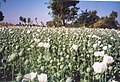 Poppy crop from the Malwa in India
 -
 Modern vial of morphine first isolated from opium by Friedrich Sertürner
 -
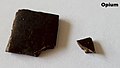 Dried latex from opium poppy
 -
 Afghanistan, Helmand province. A Marine greets local children working in the field of opium poppies near the base.
 -
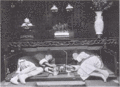 A Chinese opium house; photographed in 1902
 -
 An artist's view of an Ottoman opium seller
 -
 British opium ships
 -
 Spanish opium ball
 -
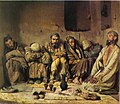 Opium-eaters by Vasily Vereshchagin depicts an opium den in Turkestan, 1868
 -
 An opium den in 18th-century China.
.jpg)


.jpg)


.jpg)


.jpg)


| Ancient anaesthesia | ||||||
|---|---|---|---|---|---|---|
|
