Stomach cancer
Cancer arising from the lining or tissues of the stomach

Editor-In-Chief: Prab R Tumpati, MD
Obesity, Sleep & Internal medicine
Founder, WikiMD Wellnesspedia &
W8MD's weight loss doctor NYC
Philadelphia GLP-1 weight loss and GLP-1 clinic NYC
Stomach cancer, also called gastric cancer, is a cancer that begins in the stomach, most often in the gland-forming cells of the stomach lining. The most common type is gastric adenocarcinoma. Less common malignant tumors of the stomach include gastric lymphoma, gastrointestinal stromal tumors, and neuroendocrine tumors.


Stomach cancer is an important global cause of cancer illness and death. It may be difficult to detect early because early symptoms are often vague and may resemble indigestion, gastritis, or peptic ulcer disease. Advanced disease may cause weight loss, abdominal pain, vomiting, difficulty swallowing, gastrointestinal bleeding, anemia, ascites, or spread to distant organs.
Overview[edit]
The stomach is a hollow organ in the upper abdomen that receives food from the esophagus, mixes it with gastric acid and digestive enzymes, and gradually empties partially digested food into the duodenum. Stomach cancer develops when cells in the stomach acquire genetic and molecular changes that allow uncontrolled growth, invasion of surrounding tissues, and possible metastasis.
Most stomach cancers arise from the mucosal lining of the stomach and are classified as adenocarcinomas. Stomach cancer may occur in different regions of the stomach, including the cardia near the gastroesophageal junction, the body, the antrum, and the pylorus. Tumor location can influence symptoms, treatment, and prognosis.
Other names[edit]
Stomach cancer is also known as:
- Gastric cancer
- Stomach carcinoma
- Gastric carcinoma
- Adult stomach cancer
- Adult stomach carcinoma
- Cancer of the stomach
Anatomy of the stomach[edit]
The stomach is part of the digestive system. It is located between the esophagus and the small intestine. Major regions include:
- Cardia - the area near the gastroesophageal junction
- Fundus - the upper curved portion
- Body - the main central region
- Antrum - the lower region that grinds and mixes food
- Pylorus - the outlet into the duodenum
The stomach wall includes several layers:
The depth of tumor invasion through these layers is a key part of cancer staging.
Types of stomach cancer[edit]
Gastric adenocarcinoma[edit]
Gastric adenocarcinoma is the most common type of stomach cancer. It begins in glandular cells of the stomach lining. It may be divided into intestinal and diffuse patterns.
Intestinal type[edit]
The intestinal type is often associated with chronic inflammation, Helicobacter pylori infection, atrophic gastritis, and intestinal metaplasia. It may form a more distinct mass.
Diffuse type[edit]
The diffuse type tends to infiltrate the stomach wall and may cause thickening and rigidity known as linitis plastica. It may contain signet ring cells and can be associated with inherited mutations in the CDH1 gene.
Gastric lymphoma[edit]
Gastric lymphoma is a cancer of lymphoid tissue in the stomach. Some cases are associated with Helicobacter pylori infection, especially MALT lymphoma.
Gastrointestinal stromal tumor[edit]
A gastrointestinal stromal tumor or GIST is a tumor arising from specialized cells in the wall of the gastrointestinal tract. Gastric GIST is biologically distinct from gastric adenocarcinoma and is treated differently.
Gastric neuroendocrine tumor[edit]
Gastric neuroendocrine tumors arise from hormone-producing cells in the stomach. Their behavior ranges from slow-growing to aggressive depending on tumor type and grade.
Causes and pathogenesis[edit]
Stomach cancer develops through a combination of environmental, infectious, inflammatory, dietary, and genetic factors. The best-established risk factor for non-cardia gastric adenocarcinoma is chronic infection with Helicobacter pylori. Long-standing H. pylori infection can lead to chronic gastritis, atrophic gastritis, intestinal metaplasia, dysplasia, and eventually carcinoma in susceptible individuals.
Important biological pathways include:
- Chronic inflammation
- Oxidative stress
- DNA damage
- Genetic mutation
- Epigenetic change
- Tumor suppressor gene inactivation
- Oncogene activation
- Abnormal cell proliferation
- Angiogenesis
- Immune evasion
Risk factors[edit]
Risk factors for stomach cancer include infection, lifestyle factors, dietary habits, inherited conditions, and certain stomach diseases.
Helicobacter pylori infection[edit]
Helicobacter pylori is a bacterium that infects the stomach lining. Chronic infection is associated with chronic gastritis, peptic ulcer disease, gastric atrophy, intestinal metaplasia, and increased risk of gastric cancer.
Dietary factors[edit]
Dietary risks may include:
- Diet high in salted foods
- Diet high in smoked foods
- Diet high in pickled foods
- Low intake of fruits and vegetables
- Foods preserved or stored improperly
- High exposure to nitrates or nitrosamines
A diet rich in fruits, vegetables, and minimally processed foods may help reduce risk.
Smoking and alcohol[edit]
Smoking increases the risk of stomach cancer and many other cancers. Alcohol use may also contribute to risk, especially when heavy or combined with other risk factors.
Age and sex[edit]
Stomach cancer is more common in older adults and is more frequent in men than women.
Family history and genetics[edit]
A family history of stomach cancer increases risk. Inherited cancer syndromes associated with gastric cancer include:
- Hereditary diffuse gastric cancer
- Lynch syndrome
- Familial adenomatous polyposis
- Peutz-Jeghers syndrome
- Li-Fraumeni syndrome
Chronic stomach conditions[edit]
Conditions associated with increased risk include:
- Chronic atrophic gastritis
- Intestinal metaplasia
- Pernicious anemia
- Gastric polyps
- Ménétrier disease
- Prior stomach surgery
- Epstein-Barr virus-associated gastric cancer
Obesity and gastroesophageal reflux[edit]
Obesity and chronic gastroesophageal reflux disease are associated with increased risk of cancers near the gastroesophageal junction and gastric cardia.
Signs and symptoms[edit]
Early stomach cancer may cause no symptoms or only vague symptoms. Many symptoms overlap with benign conditions such as gastritis, acid reflux, and peptic ulcer disease.
Early symptoms[edit]
Early symptoms may include:
- Indigestion
- Upper abdominal discomfort
- Bloating after meals
- Early satiety, or feeling full quickly
- Mild nausea
- Loss of appetite
- Heartburn
- Fatigue from early anemia
Advanced symptoms[edit]
Advanced stomach cancer may cause:
- Unexplained weight loss
- Persistent abdominal pain
- Persistent vomiting
- Blood in stool
- Black stools or melena
- Vomiting blood
- Progressive difficulty swallowing
- Jaundice
- Ascites
- Abdominal swelling
- Anemia
- Weakness
- Enlarged lymph nodes
- Signs of metastasis
When to call a doctor[edit]
A person should contact a health care provider if they have persistent or worsening symptoms such as unexplained weight loss, vomiting, difficulty swallowing, black stools, blood in vomit, persistent abdominal pain, or anemia. Emergency care is needed for severe bleeding, fainting, severe abdominal pain, or signs of shock.
Diagnosis[edit]
Diagnosis of stomach cancer usually requires visualization of the stomach and tissue confirmation by biopsy. NCI describes upper endoscopy with biopsy as a key diagnostic test, and other tests may include barium swallow, CT scan, biomarker testing, and evaluation for H. pylori infection. :contentReference[oaicite:2]{index=2}

History and physical examination[edit]
The clinician asks about symptoms, duration, weight loss, bleeding, appetite, swallowing difficulty, family history, diet, smoking, alcohol use, prior stomach disease, and medication use. Physical examination may check for abdominal masses, tenderness, ascites, enlarged lymph nodes, signs of anemia, and jaundice.
Blood tests[edit]
Blood tests may include:
- Complete blood count
- Comprehensive metabolic panel
- Liver function test
- Iron studies
- Vitamin B12
- Coagulation tests
- Tumor markers in selected cases
A complete blood count may show anemia from chronic blood loss.
Upper endoscopy[edit]
Upper endoscopy allows direct visualization of the esophagus, stomach, and duodenum. During the procedure, the physician can identify abnormal areas and take biopsy samples.
Biopsy and pathology[edit]
A biopsy is the removal of tissue for examination under a microscope. The pathologist determines the tumor type, grade, and histologic features.
Pathology may identify:
- Adenocarcinoma
- Signet ring cells
- Poor differentiation
- Lymphovascular invasion
- Perineural invasion
- HER2 expression
- Microsatellite instability
- Mismatch repair deficiency
- PD-L1 expression
- Epstein-Barr virus-associated features
HER2, PD-L1, MSI, and molecular testing[edit]
Molecular testing is increasingly important in advanced gastric cancer. Tumor testing may include:
- HER2 testing
- PD-L1 expression
- Microsatellite instability or MSI testing
- Mismatch repair status
- Next-generation sequencing in selected cases
- Claudin 18.2 testing where clinically relevant
- EBV testing in selected cases
HER2-positive advanced gastric cancer may be treated with HER2-targeted therapy such as trastuzumab in selected patients.
Barium swallow and upper GI series[edit]
A barium swallow or upper GI series uses x-rays after swallowing barium contrast. It may show narrowing, masses, ulcers, or abnormal stomach contour, but it does not replace biopsy.
CT scan[edit]
A CT scan of the chest, abdomen, and pelvis is commonly used for staging. It can assess tumor extent, lymph nodes, liver metastases, peritoneal disease, and other spread.
Endoscopic ultrasound[edit]
Endoscopic ultrasound can help determine depth of tumor invasion and involvement of nearby lymph nodes, especially when potentially curative treatment is being considered.
PET scan[edit]
A positron emission tomography scan may be used in selected cases to look for distant spread, depending on tumor type and clinical situation.
Staging laparoscopy[edit]
Staging laparoscopy may be used before major surgery to detect small peritoneal metastases not seen on imaging.
Staging[edit]
Cancer staging describes how far the cancer has spread. Stomach cancer is commonly staged using the TNM staging system:
- T - depth of tumor invasion into the stomach wall or nearby structures
- N - spread to regional lymph nodes
- M - distant metastasis
Stages range from early localized disease to advanced metastatic disease. ACS notes that staging helps determine whether surgery is appropriate and that chemotherapy and/or immunotherapy may be given before and after surgery in some cases. :contentReference[oaicite:3]{index=3}
Differential diagnosis[edit]
Conditions that may resemble stomach cancer include:
- Peptic ulcer disease
- Gastritis
- Gastroesophageal reflux disease
- Functional dyspepsia
- Esophageal cancer
- Pancreatic cancer
- Gallbladder disease
- Cholecystitis
- Hepatitis
- Gastric lymphoma
- Gastrointestinal stromal tumor
- Gastroparesis
- Inflammatory bowel disease
Treatment[edit]
Treatment depends on the cancer type, stage, tumor location, molecular markers, patient health, symptoms, and goals of care. NCI summarizes that treatment options depend on disease extent and may include surgery, chemotherapy, radiation, and immunotherapy. :contentReference[oaicite:4]{index=4} Care is ideally planned by a multidisciplinary team that may include a gastroenterologist, medical oncologist, surgical oncologist, radiation oncologist, pathologist, radiologist, dietitian, palliative care specialist, and oncology nurse.
Common treatment approaches include:
- Endoscopic mucosal resection
- Endoscopic submucosal dissection
- Surgery
- Chemotherapy
- Radiation therapy
- Chemoradiation
- Targeted therapy
- Immunotherapy
- Palliative care
- Nutritional support
Endoscopic treatment for early disease[edit]
Very early stomach cancers limited to the mucosa and meeting strict criteria may be treated with endoscopic techniques.
Procedures include:
These procedures remove the abnormal area through an endoscope without open surgery.
Surgery[edit]
Surgery is a key treatment for potentially curable stomach cancer. The type of surgery depends on tumor location and extent.
Subtotal gastrectomy[edit]
Subtotal gastrectomy removes the part of the stomach containing the cancer, along with nearby lymph nodes and sometimes adjacent tissues.
Total gastrectomy[edit]
Total gastrectomy removes the entire stomach, nearby lymph nodes, and sometimes parts of nearby organs. The esophagus is connected to the small intestine so the patient can swallow food.
Lymph node dissection[edit]
Removal of regional lymph nodes is important for staging and local disease control.
Palliative surgery and procedures[edit]
If the cancer cannot be completely removed, procedures may help relieve symptoms such as obstruction or bleeding.
Options may include:
- Endoluminal stent placement
- Gastrojejunostomy
- Endoscopic laser therapy
- Feeding tube placement
- Bypass surgery
Chemotherapy[edit]
Chemotherapy uses drugs to kill cancer cells or stop them from dividing. It may be given:
- Before surgery as neoadjuvant therapy
- After surgery as adjuvant therapy
- Before and after surgery as perioperative therapy
- With radiation as chemoradiation
- For advanced or metastatic disease
- For symptom control in palliative care
Common chemotherapy drugs and regimens vary by region, stage, and patient factors.
Radiation therapy[edit]
Radiation therapy uses high-energy rays to destroy cancer cells. It may be used with chemotherapy after surgery, before surgery in selected cases, or for symptom control.
Chemoradiation[edit]
Chemoradiation combines chemotherapy with radiation therapy. Chemotherapy can make cancer cells more sensitive to radiation. Chemoradiation may be used before or after surgery in selected patients.
Targeted therapy[edit]
Targeted therapy uses drugs that attack specific molecular features of cancer cells.
Examples include:
- Trastuzumab for selected HER2-positive gastric or gastroesophageal junction cancers
- Ramucirumab, which targets pathways involved in tumor blood vessel growth
- Other targeted therapies based on tumor biomarkers and availability
Immunotherapy[edit]
Immunotherapy uses the immune system to fight cancer. Immune checkpoint inhibitors may be used in selected advanced stomach cancers depending on tumor markers and prior treatment.
Examples include:
- Pembrolizumab
- Nivolumab
- Other immune checkpoint inhibitors depending on region, approval, and tumor characteristics
Treatment of advanced or metastatic disease[edit]
Advanced stomach cancer may be treated with systemic therapy, symptom-directed procedures, and supportive care. Treatment may include chemotherapy, immunotherapy, targeted therapy, clinical trials, nutritional support, pain control, and palliative care.
Clinical trials[edit]
Clinical trials may offer access to new treatments, combinations, biomarkers, and supportive care strategies. Patients should ask their oncology team whether a clinical trial is appropriate.
Nutrition and supportive care[edit]
Stomach cancer and its treatment can affect eating, digestion, weight, and nutrient absorption.
Supportive care may include:
- Nutrition counseling
- Small frequent meals
- High-protein and high-calorie foods
- Management of nausea and vomiting
- Treatment of anemia
- Vitamin B12 monitoring after total gastrectomy
- Iron, calcium, vitamin D, and other supplementation when needed
- Feeding tube support in selected patients
- Management of dumping syndrome after surgery
- Pain control
- Psychosocial support
Palliative care[edit]
Palliative care focuses on symptom relief, quality of life, decision support, and family support. It can be used at any stage of serious illness and may be provided alongside cancer treatment.
Palliative care may help with:
- Pain
- Nausea
- Vomiting
- Weight loss
- Fatigue
- Anxiety
- Depression
- Obstruction
- Bleeding
- Ascites
- Goals-of-care discussions
Prevention[edit]
Not all stomach cancers can be prevented, but risk may be reduced by addressing modifiable factors.
Prevention strategies include:
- Helicobacter pylori eradication when indicated
- Smoking cessation
- Maintaining a healthy body weight
- Eating fruits and vegetables
- Limiting salted, smoked, and heavily processed foods
- Limiting alcohol
- Proper food storage and preparation
- Managing chronic gastritis and premalignant conditions
- Genetic counseling and surveillance for high-risk families
ACS notes that H. pylori infection, excess body weight, diet, alcohol, tobacco, prior stomach surgery, some stomach polyps, pernicious anemia, Ménétrier disease, and inherited cancer syndromes are among risk factors. :contentReference[oaicite:5]{index=5}
Screening and surveillance[edit]
Population screening for stomach cancer is common in some high-incidence countries but is not routine everywhere. Screening may be considered in high-risk groups, depending on local guidelines and individual risk.
People who may need special surveillance include those with:
- Strong family history of stomach cancer
- Hereditary diffuse gastric cancer
- Gastric intestinal metaplasia
- Chronic atrophic gastritis
- Pernicious anemia
- Prior gastric dysplasia
- Certain inherited cancer syndromes
- Prior early gastric cancer treatment
Prognosis[edit]
The prognosis of stomach cancer depends strongly on stage at diagnosis. Early cancers confined to the stomach lining have a better chance of cure. Advanced cancers with lymph node involvement, peritoneal spread, or distant metastases are more difficult to cure.
Important prognostic factors include:
- Stage
- Tumor depth
- Lymph node involvement
- Metastasis
- Surgical resectability
- Tumor grade
- Histologic subtype
- Molecular markers
- Response to therapy
- Nutritional status
- Overall health
Patient education[edit]
Patients with stomach cancer should discuss the following with their care team:
- Cancer type and stage
- Whether the cancer is resectable
- Treatment goals
- Surgery options
- Need for chemotherapy, radiation, targeted therapy, or immunotherapy
- Tumor marker testing such as HER2, PD-L1, MSI, and mismatch repair
- Side effects of treatment
- Nutrition plan
- Clinical trial options
- Palliative care and symptom control
- Follow-up schedule
- Warning signs requiring urgent care
Questions to ask the doctor[edit]
Useful questions include:
- What type of stomach cancer do I have?
- What stage is the cancer?
- Has the cancer spread?
- Is surgery possible?
- Do I need chemotherapy before or after surgery?
- Should my tumor be tested for HER2, PD-L1, MSI, or other biomarkers?
- Am I a candidate for targeted therapy or immunotherapy?
- What are the expected side effects?
- How will treatment affect eating and digestion?
- Do I need a dietitian?
- Are clinical trials available?
- What symptoms should make me call right away?
- What is the goal of treatment: cure, control, or comfort?
Gallery[edit]
-
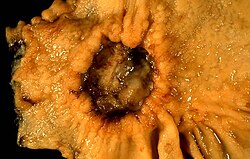 Adenocarcinoma of the stomach on histopathology
 -
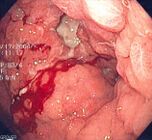 Linitis plastica seen on endoscopy
 -
 Endoscopic images of early stomach cancer with signet ring cells

See also[edit]
- Cancer
- Gastric cancer
- Gastric adenocarcinoma
- Stomach
- Digestive system
- Gastroenterology
- Oncology
- Gastrointestinal oncology
- Helicobacter pylori
- Chronic gastritis
- Peptic ulcer disease
- Pernicious anemia
- Intestinal metaplasia
- Gastric polyp
- Linitis plastica
- Signet ring cell carcinoma
- Upper endoscopy
- Biopsy
- CT scan
- Endoscopic ultrasound
- Gastrectomy
- Chemotherapy
- Radiation therapy
- Targeted therapy
- Immunotherapy
- Trastuzumab
- Ramucirumab
- Pembrolizumab
- Nivolumab
- Palliative care
- Cancer screening
- Cancer prevention
External links[edit]
- National Cancer Institute: Stomach Cancer
- American Cancer Society: Stomach Cancer
- MedlinePlus: Stomach Cancer
- ClinicalTrials.gov: Stomach Cancer Studies
| Digestive system neoplasia | ||||||||||||||||||||||||
|---|---|---|---|---|---|---|---|---|---|---|---|---|---|---|---|---|---|---|---|---|---|---|---|---|
|
| Overview of tumors, cancer and oncology (C00–D48, 140–239) | ||||||||||||||||||||||
|---|---|---|---|---|---|---|---|---|---|---|---|---|---|---|---|---|---|---|---|---|---|---|
|
| Health science - Medicine - Gastroenterology - edit |
|---|
| Diseases of the esophagus - stomach |
| Halitosis | Nausea | Vomiting | GERD | Achalasia | Esophageal cancer | Esophageal varices | Peptic ulcer | Abdominal pain | Stomach cancer | Functional dyspepsia | Gastroparesis |
| Diseases of the liver - pancreas - gallbladder - biliary tree |
| Hepatitis | Cirrhosis | NASH | PBC | PSC | Budd-Chiari | Hepatocellular carcinoma | Acute pancreatitis | Chronic pancreatitis | Pancreatic cancer | Gallstones | Cholecystitis |
| Diseases of the small intestine |
| Peptic ulcer | Intussusception | Malabsorption (e.g. Coeliac, lactose intolerance, fructose malabsorption, Whipple's) | Lymphoma |
| Diseases of the colon |
| Diarrhea | Appendicitis | Diverticulitis | Diverticulosis | IBD (Crohn's, Ulcerative colitis) | IBS | Constipation | Colorectal cancer | Hirschsprung's | Pseudomembranous colitis |
| Oncology | ||||||||||
|---|---|---|---|---|---|---|---|---|---|---|
This oncology-related article is a stub.
|

Medical Disclaimer: WikiMD is for informational purposes only and is not a substitute for professional medical advice. Content may be inaccurate or outdated and should not be used for diagnosis or treatment. Always consult your healthcare provider for medical decisions. Verify information with trusted sources such as CDC.gov and NIH.gov. By using this site, you agree that WikiMD is not liable for any outcomes related to its content. See full disclaimer.
Credits:Most images are courtesy of Wikimedia commons, and templates, categories Wikipedia, licensed under CC BY SA or similar.
Translate page: - East Asian
中文,
日本,
한국어,
South Asian
हिन्दी,
தமிழ்,
తెలుగు,
Urdu,
ಕನ್ನಡ,
Southeast Asian
Indonesian,
Vietnamese,
Thai,
မြန်မာဘာသာ,
বাংলা
European
español,
Deutsch,
français,
Greek,
português do Brasil,
polski,
română,
русский,
Nederlands,
norsk,
svenska,
suomi,
Italian
Middle Eastern & African
عربى,
Turkish,
Persian,
Hebrew,
Afrikaans,
isiZulu,
Kiswahili,
Other
Bulgarian,
Hungarian,
Czech,
Swedish,
മലയാളം,
मराठी,
ਪੰਜਾਬੀ,
ગુજરાતી,
Portuguese,
Ukrainian

