Perforated ulcer
| Perforated Ulcer | |
|---|---|
| DU 2.jpg | |
| Synonyms | N/A |
| Pronounce | N/A |
| Specialty | N/A |
| Symptoms | Sudden severe abdominal pain, fever, nausea, vomiting |
| Complications | Peritonitis, Sepsis, Shock |
| Onset | Sudden |
| Duration | Acute |
| Types | N/A |
| Causes | Peptic ulcer disease, NSAIDs, Helicobacter pylori infection |
| Risks | Smoking, alcohol use, stress |
| Diagnosis | X-ray, CT scan, Endoscopy |
| Differential diagnosis | N/A |
| Prevention | N/A |
| Treatment | Surgical repair, antibiotics, proton pump inhibitors |
| Medication | N/A |
| Prognosis | Variable, depends on promptness of treatment |
| Frequency | N/A |
| Deaths | N/A |
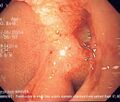
A perforated ulcer is a serious medical condition where an untreated peptic ulcer leads to a hole in the wall of the stomach or duodenum. This condition is a surgical emergency and can lead to severe complications if not treated promptly.
Pathophysiology[edit]
A perforated ulcer occurs when an ulcer erodes through the full thickness of the stomach or duodenal wall, creating an opening into the peritoneal cavity. This allows gastric contents to leak into the abdominal cavity, leading to peritonitis, an inflammation of the peritoneum. The presence of gastric acid and digestive enzymes in the peritoneal cavity can cause severe irritation and infection.
Causes[edit]
The primary causes of perforated ulcers include:
- Helicobacter pylori infection: This bacterium is a major cause of peptic ulcers and can lead to perforation if the ulcer is not treated.
- Nonsteroidal anti-inflammatory drugs (NSAIDs): These medications can irritate the stomach lining and contribute to ulcer formation and perforation.
- Excessive alcohol consumption and smoking: Both can exacerbate ulcer formation and increase the risk of perforation.
Symptoms[edit]
The symptoms of a perforated ulcer are typically sudden and severe, including:
- Sudden, intense abdominal pain
- Fever
- Nausea and vomiting
- Rigid, board-like abdomen
- Signs of shock, such as rapid heartbeat and low blood pressure
Diagnosis[edit]
Diagnosis of a perforated ulcer is based on clinical presentation and imaging studies. An X-ray may show free air under the diaphragm, indicating perforation. A CT scan can provide more detailed information about the location and extent of the perforation. Endoscopy may be used to visualize the ulcer directly.
Treatment[edit]
Treatment of a perforated ulcer typically involves emergency surgery to close the perforation and clean the peritoneal cavity. Antibiotics are administered to treat or prevent infection. Proton pump inhibitors are used to reduce gastric acid production and promote healing of the ulcer.
Prognosis[edit]
The prognosis for a perforated ulcer depends on the promptness of treatment. Early surgical intervention and appropriate medical management can lead to a good outcome, but delays in treatment can result in serious complications such as sepsis and shock.
Also see[edit]
| Health science - Medicine - Gastroenterology - edit |
|---|
| Diseases of the esophagus - stomach |
| Halitosis | Nausea | Vomiting | GERD | Achalasia | Esophageal cancer | Esophageal varices | Peptic ulcer | Abdominal pain | Stomach cancer | Functional dyspepsia | Gastroparesis |
| Diseases of the liver - pancreas - gallbladder - biliary tree |
| Hepatitis | Cirrhosis | NASH | PBC | PSC | Budd-Chiari | Hepatocellular carcinoma | Acute pancreatitis | Chronic pancreatitis | Pancreatic cancer | Gallstones | Cholecystitis |
| Diseases of the small intestine |
| Peptic ulcer | Intussusception | Malabsorption (e.g. Coeliac, lactose intolerance, fructose malabsorption, Whipple's) | Lymphoma |
| Diseases of the colon |
| Diarrhea | Appendicitis | Diverticulitis | Diverticulosis | IBD (Crohn's, Ulcerative colitis) | IBS | Constipation | Colorectal cancer | Hirschsprung's | Pseudomembranous colitis |
| Diseases of the human digestive system | ||||||||||||||||||||||||||||
|---|---|---|---|---|---|---|---|---|---|---|---|---|---|---|---|---|---|---|---|---|---|---|---|---|---|---|---|---|
|
-
 Perforated ulcer


Medical Disclaimer: WikiMD is for informational purposes only and is not a substitute for professional medical advice. Content may be inaccurate or outdated and should not be used for diagnosis or treatment. Always consult your healthcare provider for medical decisions. Verify information with trusted sources such as CDC.gov and NIH.gov. By using this site, you agree that WikiMD is not liable for any outcomes related to its content. See full disclaimer.
Credits:Most images are courtesy of Wikimedia commons, and templates, categories Wikipedia, licensed under CC BY SA or similar.
Translate page: - East Asian
中文,
日本,
한국어,
South Asian
हिन्दी,
தமிழ்,
తెలుగు,
Urdu,
ಕನ್ನಡ,
Southeast Asian
Indonesian,
Vietnamese,
Thai,
မြန်မာဘာသာ,
বাংলা
European
español,
Deutsch,
français,
Greek,
português do Brasil,
polski,
română,
русский,
Nederlands,
norsk,
svenska,
suomi,
Italian
Middle Eastern & African
عربى,
Turkish,
Persian,
Hebrew,
Afrikaans,
isiZulu,
Kiswahili,
Other
Bulgarian,
Hungarian,
Czech,
Swedish,
മലയാളം,
मराठी,
ਪੰਜਾਬੀ,
ગુજરાતી,
Portuguese,
Ukrainian

