Nonsteroidal anti-inflammatory drug
Nonsteroidal anti-inflammatory drugs (NSAIDs) are a class of medications used primarily for their analgesic (pain-relieving), antipyretic (fever-reducing), and anti-inflammatory effects. NSAIDs work by inhibiting the cyclooxygenase (COX) enzymes responsible for the production of prostaglandins, which play a key role in inflammation, pain, and fever. This article provides an overview of NSAIDs, their mechanism of action, uses, side effects, contraindications, and interactions.
Mechanism of action[edit]
NSAIDs inhibit the cyclooxygenase (COX) enzymes, COX-1 and COX-2, which are involved in the synthesis of prostaglandins. Prostaglandins are lipid compounds that mediate various physiological processes, including inflammation, pain, and fever. By inhibiting COX enzymes, NSAIDs reduce the production of prostaglandins, thereby alleviating pain, inflammation, and fever.
Uses[edit]
NSAIDs are commonly used to manage a variety of conditions and symptoms, including:
- Pain relief: NSAIDs are often used to treat mild to moderate pain resulting from headaches, dental pain, menstrual cramps, muscle aches, and arthritis.
- Fever reduction: NSAIDs, such as ibuprofen, can help reduce fever.
- Inflammation reduction: NSAIDs are used to manage the inflammation associated with conditions such as osteoarthritis, rheumatoid arthritis, and gout.
Side effects[edit]
NSAIDs can cause various side effects, some of which may be serious. Common side effects include:
- Gastrointestinal issues: NSAIDs can cause stomach pain, heartburn, nausea, vomiting, and even ulcers or gastrointestinal bleeding in some cases.
- Cardiovascular risk: Some NSAIDs, particularly when used at high doses or for long periods, may increase the risk of heart attack and stroke.
- Kidney damage: Long-term use of NSAIDs may lead to kidney damage or failure.
Contraindications[edit]
NSAIDs are contraindicated in certain situations, such as:
- Allergy to NSAIDs or aspirin: Patients with a history of allergic reactions to NSAIDs or aspirin should avoid taking these medications.
- Active gastrointestinal bleeding: NSAIDs should not be used in patients with active gastrointestinal bleeding due to their potential to worsen the bleeding.
- Severe kidney disease or liver disease: Patients with severe kidney or liver disease should avoid NSAIDs, as they may exacerbate the condition.
- Pregnancy: NSAIDs should be avoided during the third trimester of pregnancy, as they can cause premature closure of the ductus arteriosus, a vital fetal blood vessel.
Drug interactions[edit]
NSAIDs may interact with various medications, including:
- Anticoagulants: Combining NSAIDs with anticoagulants, such as warfarin, may increase the risk of bleeding.
- Other NSAIDs: Concurrent use of multiple NSAIDs should be avoided, as it increases the risk of side effects.
- ACE inhibitors and angiotensin II receptor blockers: NSAIDs may reduce the effectiveness of these medications and increase the risk of kidney damage.
See also[edit]
Analgesic Antipyretic Cyclooxygenase Ibuprofen Nonsteroidal Antiinflammatory Drugs (NSAIDs)
Acetaminophen, Celecoxib, Diclofenac, Diflunisal, Etodolac, Fenoprofen, Flurbiprofen, Ibuprofen, Indomethacin, Ketoprofen, Ketorolac, Mefenamic Acid, Meloxicam, Nabumetone, Naproxen, Nimesulide, Oxaprozin, Phenylbutazone, Piroxicam, Rofecoxib, Sulindac, Tolmetin
-
 200mg Ibuprofen Tablets
 -
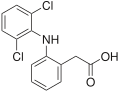 Diclofenac Structure
 -
 Kolbe-Schmitt Reaction Mechanism


Medical Disclaimer: WikiMD is for informational purposes only and is not a substitute for professional medical advice. Content may be inaccurate or outdated and should not be used for diagnosis or treatment. Always consult your healthcare provider for medical decisions. Verify information with trusted sources such as CDC.gov and NIH.gov. By using this site, you agree that WikiMD is not liable for any outcomes related to its content. See full disclaimer.
Credits:Most images are courtesy of Wikimedia commons, and templates, categories Wikipedia, licensed under CC BY SA or similar.
Translate page: - East Asian
中文,
日本,
한국어,
South Asian
हिन्दी,
தமிழ்,
తెలుగు,
Urdu,
ಕನ್ನಡ,
Southeast Asian
Indonesian,
Vietnamese,
Thai,
မြန်မာဘာသာ,
বাংলা
European
español,
Deutsch,
français,
Greek,
português do Brasil,
polski,
română,
русский,
Nederlands,
norsk,
svenska,
suomi,
Italian
Middle Eastern & African
عربى,
Turkish,
Persian,
Hebrew,
Afrikaans,
isiZulu,
Kiswahili,
Other
Bulgarian,
Hungarian,
Czech,
Swedish,
മലയാളം,
मराठी,
ਪੰਜਾਬੀ,
ગુજરાતી,
Portuguese,
Ukrainian

