Sugarman syndrome: Difference between revisions
CSV import |
CSV import |
||
| Line 50: | Line 50: | ||
[[Category:Genetic disorders]] | [[Category:Genetic disorders]] | ||
[[Category:Dermatology]] | [[Category:Dermatology]] | ||
<gallery> | |||
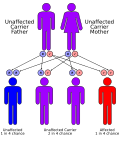
File:autorecessive.svg|Sugarman syndrome | |||
</gallery> | |||
Latest revision as of 00:44, 20 February 2025
| Sugarman syndrome | |
|---|---|
| autorecessive.svg | |
| Synonyms | N/A |
| Pronounce | N/A |
| Specialty | N/A |
| Symptoms | Ichthyosis, Hypogonadism, Short stature |
| Complications | N/A |
| Onset | Childhood |
| Duration | Lifelong |
| Types | N/A |
| Causes | Genetic mutation |
| Risks | N/A |
| Diagnosis | Genetic testing, Clinical evaluation |
| Differential diagnosis | N/A |
| Prevention | N/A |
| Treatment | Symptomatic treatment, Hormone therapy |
| Medication | N/A |
| Prognosis | Variable |
| Frequency | N/A |
| Deaths | N/A |
Sugarman syndrome is a rare genetic disorder characterized by a combination of ichthyosis, hypogonadism, and short stature. It is inherited in an autosomal recessive pattern, meaning that an individual must inherit two copies of the mutated gene, one from each parent, to be affected by the condition.
Presentation[edit]
Individuals with Sugarman syndrome typically present with symptoms in childhood. The hallmark features include:
- Ichthyosis: A condition characterized by dry, scaly skin. The severity can vary, and it often requires regular moisturizing and skin care.
- Hypogonadism: Underdevelopment of the gonads, leading to reduced levels of sex hormones. This can result in delayed or absent puberty and may require hormone replacement therapy.
- Short stature: A significantly shorter height than average for the individual's age and sex. Growth hormone therapy may be considered in some cases.
Genetics[edit]
Sugarman syndrome is caused by mutations in a specific gene, though the exact gene responsible has not been definitively identified. The condition follows an autosomal recessive inheritance pattern, as depicted in the accompanying image.
Diagnosis[edit]
Diagnosis of Sugarman syndrome is based on clinical evaluation and genetic testing. A detailed family history and physical examination are crucial. Genetic testing can confirm the diagnosis by identifying mutations in the suspected gene.
Management[edit]
There is no cure for Sugarman syndrome, and treatment is primarily symptomatic. Management strategies include:
- Regular skin care to manage ichthyosis
- Hormone replacement therapy for hypogonadism
- Growth hormone therapy for short stature, if indicated
Prognosis[edit]
The prognosis for individuals with Sugarman syndrome varies depending on the severity of symptoms and the effectiveness of management strategies. With appropriate care, individuals can lead relatively normal lives.
Also see[edit]
| Genetic disorders relating to deficiencies of transcription factor or coregulators | ||||||||||||||||||||||||||||||||||
|---|---|---|---|---|---|---|---|---|---|---|---|---|---|---|---|---|---|---|---|---|---|---|---|---|---|---|---|---|---|---|---|---|---|---|
|
-
 Sugarman syndrome

