Pili multigemini: Difference between revisions
mNo edit summary |
CSV import |
||
| (One intermediate revision by the same user not shown) | |||
| Line 1: | Line 1: | ||
= Pili Multigemini = | {{Infobox medical condition | ||
| name = Pili Multigemini | |||
| image = Pili Multigemini.jpg | |||
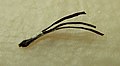
| caption = Cross-section of a hair follicle showing pili multigemini | |||
| field = Dermatology | |||
}} | |||
'''Pili multigemini''' is a rare [[hair follicle]] disorder characterized by the emergence of multiple hair shafts from a single follicle. This condition is considered a variant of [[pili bifurcati]] and is often observed in the [[scalp]], [[beard]], and other areas of the body where hair grows. | |||
Pili multigemini | |||
==Pathophysiology== | |||
Pili multigemini occurs when multiple hair matrices form within a single follicle, leading to the development of several hair shafts that emerge together. This phenomenon is due to the presence of multiple [[dermal papillae]] within a single follicle, each capable of producing a hair shaft. The exact cause of this condition is not well understood, but it is believed to be a developmental anomaly of the hair follicle. | |||
== | ==Clinical Presentation== | ||
Patients with pili multigemini may notice clusters of hair emerging from a single pore. These clusters can appear as thick, coarse hair and may be more noticeable in areas where hair is typically finer. The condition is usually asymptomatic, but some individuals may experience cosmetic concerns or difficulty with shaving or hair removal. | |||
== | ==Diagnosis== | ||
Diagnosis of pili multigemini is primarily clinical, based on the characteristic appearance of multiple hair shafts emerging from a single follicle. Dermoscopy can aid in visualization, and a [[biopsy]] may be performed to confirm the diagnosis by histological examination. | |||
== | ==Management== | ||
Pili multigemini is generally a benign condition that does not require treatment. However, if cosmetic concerns arise, options such as [[laser hair removal]] or electrolysis may be considered to reduce the appearance of the affected hair. | |||
== | ==Prognosis== | ||
The prognosis for individuals with pili multigemini is excellent, as the condition is benign and does not lead to any significant health issues. It is primarily a cosmetic concern. | |||
[[ | ==Also see== | ||
* [[Pili bifurcati]] | |||
* [[Trichostasis spinulosa]] | |||
* [[Hypertrichosis]] | |||
* [[Dermatology]] | |||
{{Dermatology}} | |||
[[Category:Dermatology]] | [[Category:Dermatology]] | ||
[[Category:Hair | [[Category:Hair diseases]] | ||
<gallery> | |||
File:Pili Multigemini.jpg|Pili multigemini | |||
</gallery> | |||
Latest revision as of 01:23, 20 February 2025
| Pili Multigemini | |
|---|---|
| Pili Multigemini.jpg | |
| Synonyms | N/A |
| Pronounce | N/A |
| Specialty | N/A |
| Symptoms | N/A |
| Complications | N/A |
| Onset | N/A |
| Duration | N/A |
| Types | N/A |
| Causes | N/A |
| Risks | N/A |
| Diagnosis | N/A |
| Differential diagnosis | N/A |
| Prevention | N/A |
| Treatment | N/A |
| Medication | N/A |
| Prognosis | N/A |
| Frequency | N/A |
| Deaths | N/A |
Pili multigemini is a rare hair follicle disorder characterized by the emergence of multiple hair shafts from a single follicle. This condition is considered a variant of pili bifurcati and is often observed in the scalp, beard, and other areas of the body where hair grows.
Pathophysiology[edit]
Pili multigemini occurs when multiple hair matrices form within a single follicle, leading to the development of several hair shafts that emerge together. This phenomenon is due to the presence of multiple dermal papillae within a single follicle, each capable of producing a hair shaft. The exact cause of this condition is not well understood, but it is believed to be a developmental anomaly of the hair follicle.
Clinical Presentation[edit]
Patients with pili multigemini may notice clusters of hair emerging from a single pore. These clusters can appear as thick, coarse hair and may be more noticeable in areas where hair is typically finer. The condition is usually asymptomatic, but some individuals may experience cosmetic concerns or difficulty with shaving or hair removal.
Diagnosis[edit]
Diagnosis of pili multigemini is primarily clinical, based on the characteristic appearance of multiple hair shafts emerging from a single follicle. Dermoscopy can aid in visualization, and a biopsy may be performed to confirm the diagnosis by histological examination.
Management[edit]
Pili multigemini is generally a benign condition that does not require treatment. However, if cosmetic concerns arise, options such as laser hair removal or electrolysis may be considered to reduce the appearance of the affected hair.
Prognosis[edit]
The prognosis for individuals with pili multigemini is excellent, as the condition is benign and does not lead to any significant health issues. It is primarily a cosmetic concern.
Also see[edit]
-
 Pili multigemini

