Silicosis: Difference between revisions
No edit summary Tag: visualeditor |
CSV import |
||
| Line 98: | Line 98: | ||
{{rarediseases}} | {{rarediseases}} | ||
{{stub}} | {{stub}} | ||
<gallery> | |||
File:Coupe de poumon atteint de silicose.jpg|Silicosis | |||
File:8.- Miner's lung with silicosis and tuberculosis.jpg|Miner's lung with silicosis and tuberculosis | |||
File:Silicosis simple.jpg|Simple silicosis | |||
File:Silicosis complicada.jpg|Complicated silicosis | |||
File:Silicosis.ILO Classification 2-2 R-R.jpg|Silicosis ILO Classification 2-2 R-R | |||
File:Fibrothorax and pleural effusion caused by silicosis (X-ray).png|Fibrothorax and pleural effusion caused by silicosis (X-ray) | |||
File:A new field-based approach to silica monitoring for mines.webm|A new field-based approach to silica monitoring for mines | |||
File:DustWorker.jpg|Dust Worker | |||
</gallery> | |||
Revision as of 00:59, 20 February 2025
Other Names: Chronic silicosis; Accelerated silicosis; Acute silicosis; Experimental silicosis
Silicosis is a lung disease caused by breathing in (inhaling) silica dust.
Types
There are three types of silicosis:
Simple chronic silicosis, the most common type of silicosis, results from long-term exposure (usually more than 20 years) to low amounts of silica dust. Simple chronic silicosis may cause people to have difficulty breathing.
Accelerated silicosis occurs after 5 to 15 years of exposure of higher levels of silica. Swelling of the lungs and other symptoms occur faster in this type of silicosis than in the simple chronic form.
Acute silicosis results from short-term exposure (weeks or months) of large amounts of silica. The lungs become very inflamed and can fill with fluid, causing severe shortness of breath and low blood oxygen levels. A cough, weight loss, and fatigue may also be present. Acute silicosis progresses rapidly and can be fatal within months.
Cause
Silicosis is caused by breathing in tiny bits of silica dust. When people breathe silica dust, they inhale tiny particles of silica that has crystallized. This silica dust can cause fluid buildup and scar tissue in the lungs that cuts down the ability to breathe.
Risk factors
People who work in jobs where they are exposed to silica dust are at risk. These jobs include:
- Abrasives manufacturing
- Glass manufacturing
- Mining
- Quarrying
- Road and building construction
- Sand blasting
- Stone cutting
Intense exposure to silica can cause disease within a year. But it usually takes at least 10 to 15 years of exposure before symptoms occur. Silicosis has become less common since the Occupational Safety and Health Administration (OSHA) created regulations requiring the use of protective equipment, which limits the amount of silica dust workers inhale.
Signs and symptoms
Symptoms of silicosis may include:
- Chronic cough
- Shortness of breath with exercise, usually in patients who have progressive massive fibrosis
- Weakness
Other symptoms of this disease, especially in acute silicosis, may also include:
- Cough
- Fever
- Severe breathing difficulty
- Weight loss
- Night Sweats
- Chest pains
Diagnosis
Your health care provider will take a medical history. You'll be asked about your jobs (past and present), hobbies, and other activities that may have exposed you to silica. The provider will also do a physical exam.
Tests to confirm the diagnosis and rule out similar diseases include:
- Chest x-ray
- Chest CT scan
- Pulmonary function tests
- Tests for tuberculosis
- Blood tests for connective tissue diseases
Treatment
There is no specific treatment for silicosis. Removing the source of silica exposure is important to prevent the disease from getting worse. Supportive treatment includes cough medicine, bronchodilators, and oxygen if needed. Antibiotics are prescribed for respiratory infections as needed.
Treatment also includes limiting exposure to irritants and quitting smoking. People with silicosis are at high risk of developing tuberculosis (TB). Silica is believed to interfere with the body's immune response to the bacteria that cause TB. Skin tests to check for exposure to TB should be done regularly. Those with a positive skin test should be treated with anti-TB drugs. Any change in the appearance of the chest x-ray may be a sign of TB.
People with severe silicosis may need to have a lung transplant.
Prognosis
Outcome varies, depending on the amount of damage to the lungs.
Possible Complications
Silicosis can lead to the following health problems:
- Connective tissue disease, including rheumatoid arthritis, scleroderma (also called progressive systemic sclerosis), and systemic lupus erythematosus
- Lung cancer
- Progressive massive fibrosis
- Respiratory failure
- Tuberculosis
Prevention
If you work in a high-risk occupation or have a high-risk hobby, always wear a dust mask and do not smoke. You might also want to use other protection recommended by OSHA, such as a respirator.
| Diseases of the respiratory system | ||||||||||||||||||||||||||||||||||||||
|---|---|---|---|---|---|---|---|---|---|---|---|---|---|---|---|---|---|---|---|---|---|---|---|---|---|---|---|---|---|---|---|---|---|---|---|---|---|---|
|
NIH genetic and rare disease info
Silicosis is a rare disease.
| Rare and genetic diseases | ||||||
|---|---|---|---|---|---|---|
|
Rare diseases - Silicosis
|
 | This medical article is a stub. You can help WikiMD by expanding the page. |
-
 Silicosis
 -
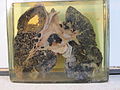 Miner's lung with silicosis and tuberculosis
 -
 Simple silicosis
 -
 Complicated silicosis
 -
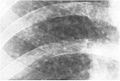 Silicosis ILO Classification 2-2 R-R
 -
 Fibrothorax and pleural effusion caused by silicosis (X-ray)
 -
 A new field-based approach to silica monitoring for mines
 -
 Dust Worker


.png)

