Endemic Kaposi sarcoma
Other Names: African Kaposi sarcoma; African/endemic Kaposi sarcoma Kaposi's sarcoma (KS) is a type of cancer that can form masses in the skin, lymph nodes, or other organs. The skin lesions are usually purple in color. They can occur singularly, in a limited area, or be widespread. Kaposi’s sarcoma (KS) is the most common tumor in HIV-infected individuals in Africa KS is a vascular tumor which arises in multifocal sites. The skin is most commonly involved, though virtually any organ, except perhaps the brain can be involved.


Risk factors
Kaposi's sarcoma remains the most common cancer in Sub-Saharan Africa and the second most common cancer in HIV-infected patients worldwide. Since the introduction of highly active antiretroviral therapy (HAART), there has been a decline in its incidence. However, Kaposi's sarcoma continues to be diagnosed in HIV-infected patients. Risk factors include poor immune function, either as a result of disease or specific medications, and chronic lymphedema.
Cause
Kaposi's sarcoma-associated herpesvirus (KSHV), also called HHV-8, is present in almost 100% of Kaposi sarcoma lesions, whether HIV-related, classic, endemic, or iatrogenic.
Classifications
Kasposi’s sarcoma has four classifications, based on varying clinical characteristics and risk factors
- Classic Kasposi’s sarcoma affects elderly, immunocompetent individuals of
Mediterranean or Eastern European descent. It is a slow-progressing and relatively benign form of the cancer.
- Endemic or African Kaposi’s sarcoma is most common in Central and Eastern
Africa and primarily affects adults
- Iatrogenic Kaposi’s sarcoma is found in populations with compromised immune systems, primarily in patients who have received organ transplants.
- AIDs-Kaposi’s sarcoma develops in populations infected with HIV-AIDS. In Western countries,
AIDS-KS is most commonly found in HIV-infected men who have sex with men.
Signs and symptoms
KS lesions are nodules or blotches that may be red, purple, brown, or black, and are usually papular.
They are typically found on the skin, but spread elsewhere is common, especially the mouth, gastrointestinal tract and respiratory tract. Growth can range from very slow to explosively fast, and is associated with significant mortality and morbidity.
The lesions are painless, but become cosmetically disfiguring or interruptive to organs.
Diagnostics:
First and foremost is the clinical picture of erythematous violaceous cutaneous lesions that canbe macular, patch, plaque, nodular or exophytic. The lesions can be solitary, localized or disseminated. This in the background of HIV/AIDS should alert the physician to the diagnosis of KS. The presence of local/regional lymphoedema almost gives away the diagnosis. However tissue confirmation is mandatory before instituting any form of therapy.
Local punch biopsy or rarely, excision biopsy are all that are required for a skin biopsy.
Lymphnode excision can also be done in predominantly nodal lesions. Endoscopic biopsies may berequired for lesions presenting solely in visceral lumens. Tissues should be subjected to pathologic examination by an experienced histopathologist.
Treatment
It has been noted that highly active antiretroviral therapy (HAART) alone improves the outcome of HIV associated KS
Patients with aggressive forms of KS are commonly treated with paclitaxel or doxorubicin(orliposomal doxorubicin), bleomycin and vinblastine or vincristine (ABV). The ABV regimen hasbeen shown to give better response rates than BV (Bleomycin, vinblastine / vincristine) alone. This regimen was however not very popular because of toxicity [[Gemcitabine monotherapy]] has been suggested as an alternative option in patients previously treated with ABV
Paclitaxel, with response rates ranging from 59%-71% when given without HAART (12,13), is considered the most attractive agent since it is effective and tolerable over long-term administration especially when combined with growth factors (13,14). Paclitaxel for this reason should be added to the essential medicines list.
Alpha interferon and radiotherapy have also been used in the management of AIDS-associated KS. Their use has been limited by the toxicity profile. Rapamycin was noted to be safe in HIV infected individuals with KS and can in some cases induce tumor regression
The medication(s) listed below have been approved by the Food and Drug Administration (FDA) as orphan products for treatment of this condition.
- Pazopanib (Brand name: Votrient)Advanced soft tissue sarcoma (STS) who have received prior chemotherapy.
Additional images
-
 Micrograph of promontory sign in Kaposi's sarcoma in patch stage. Dilated irregular vascular channels surround a pre-existing vessel.<ref name=Soyer2011/>
 -
 Micrograph of plaque stage, with bizarre vessels dissecting the upper dermis. There is erythrocyte extravasation and hemosiderin pigmentation.<ref name=Soyer2011/>
 -
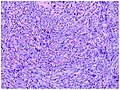 Micrograph of tumor stage. Well-circumscribed spindle-cell tumor. Erythrocytes lie within poorly defined slit-like vascular spaces.<ref name=Soyer2011/>


| Diseases of the skin and appendages by morphology | ||||||||||||||||||||||||||||||||||||||||||||||||||||||
|---|---|---|---|---|---|---|---|---|---|---|---|---|---|---|---|---|---|---|---|---|---|---|---|---|---|---|---|---|---|---|---|---|---|---|---|---|---|---|---|---|---|---|---|---|---|---|---|---|---|---|---|---|---|---|
|
| Tumours of blood vessels | ||||||
|---|---|---|---|---|---|---|
|
| Skin infections, symptoms and signs related to viruses | ||
|---|---|---|
|
NIH genetic and rare disease info
Endemic Kaposi sarcoma is a rare disease.
| Rare and genetic diseases | ||||||
|---|---|---|---|---|---|---|
|
Rare diseases - Endemic Kaposi sarcoma
|
Ad. Transform your life with W8MD's
GLP-1 weight loss injections special from $29.99 with insurance
|
WikiMD Medical Encyclopedia |
Medical Disclaimer: WikiMD is for informational purposes only and is not a substitute for professional medical advice. Content may be inaccurate or outdated and should not be used for diagnosis or treatment. Always consult your healthcare provider for medical decisions. Verify information with trusted sources such as CDC.gov and NIH.gov. By using this site, you agree that WikiMD is not liable for any outcomes related to its content. See full disclaimer.
Credits:Most images are courtesy of Wikimedia commons, and templates, categories Wikipedia, licensed under CC BY SA or similar.
Translate this page: - East Asian
中文,
日本,
한국어,
South Asian
हिन्दी,
தமிழ்,
తెలుగు,
Urdu,
ಕನ್ನಡ,
Southeast Asian
Indonesian,
Vietnamese,
Thai,
မြန်မာဘာသာ,
বাংলা
European
español,
Deutsch,
français,
Greek,
português do Brasil,
polski,
română,
русский,
Nederlands,
norsk,
svenska,
suomi,
Italian
Middle Eastern & African
عربى,
Turkish,
Persian,
Hebrew,
Afrikaans,
isiZulu,
Kiswahili,
Other
Bulgarian,
Hungarian,
Czech,
Swedish,
മലയാളം,
मराठी,
ਪੰਜਾਬੀ,
ગુજરાતી,
Portuguese,
Ukrainian
