Beta cell: Difference between revisions
CSV import |
CSV import |
||
| Line 45: | Line 45: | ||
{{Endocrine system}} | {{Endocrine system}} | ||
{{medicine-stub}} | {{medicine-stub}} | ||
== Beta cell == | |||
<gallery> | |||
File:Human_Pancreatic_Islet.tif|Human Pancreatic Islet | |||
File:Insulin_secretion.png|Insulin secretion | |||
</gallery> | |||
Latest revision as of 21:01, 23 February 2025

Beta cell
Beta cells (or β cells) are a type of cell found in the pancreas within clusters known as the islets of Langerhans. They make up 50-70% of the cells in the islets. Beta cells are responsible for the production, storage, and release of the hormone insulin, which plays a crucial role in regulating blood glucose levels.
Function[edit]
The primary function of beta cells is to sense blood glucose levels and secrete insulin in response. Insulin is a hormone that facilitates the uptake of glucose by tissues, thereby lowering blood glucose levels. When blood glucose levels rise, such as after a meal, beta cells release insulin into the bloodstream. This process is essential for maintaining homeostasis and ensuring that cells receive adequate energy.
Insulin Secretion[edit]
Insulin secretion by beta cells involves several steps: 1. **Glucose Uptake**: Glucose enters the beta cells through GLUT2 transporters. 2. **Metabolism**: Inside the cell, glucose is metabolized to produce ATP. 3. **Depolarization**: The increase in ATP/ADP ratio leads to the closure of ATP-sensitive potassium channels, causing cell membrane depolarization. 4. **Calcium Influx**: Depolarization opens voltage-dependent calcium channels, allowing calcium ions to enter the cell. 5. **Insulin Release**: The influx of calcium triggers the exocytosis of insulin-containing vesicles, releasing insulin into the bloodstream.
Role in Diabetes[edit]
Beta cells play a critical role in the pathophysiology of diabetes mellitus. In type 1 diabetes, an autoimmune response targets and destroys beta cells, leading to insufficient insulin production. In type 2 diabetes, beta cells may become dysfunctional or insufficient in the face of increased insulin demand due to insulin resistance.
Regeneration and Research[edit]
Research into beta cell regeneration and replacement is ongoing, with the aim of finding treatments for diabetes. Potential strategies include:
- **Stem cell therapy**: Differentiating stem cells into functional beta cells.
- **Islet transplantation**: Transplanting islets from a donor pancreas.
- **Gene therapy**: Modifying genes to enhance beta cell function or survival.
See Also[edit]
References[edit]
<references group="" responsive="1"></references>
External Links[edit]

| Diseases of the endocrine system (E00–E35, 240–259) | ||||||||||||||||||||||||||||||||||||||
|---|---|---|---|---|---|---|---|---|---|---|---|---|---|---|---|---|---|---|---|---|---|---|---|---|---|---|---|---|---|---|---|---|---|---|---|---|---|---|
|

Beta cell[edit]
-
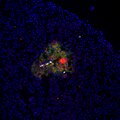 Human Pancreatic Islet
 -
 Insulin secretion

