Whipworm infection

Whipworm infection - an infection that is caused by the nematode trichuris trichiura, a soil-transmitted helminth, which is transmitted via food and/or water contaminated with the eggs of the worm. Symptoms are usually mild and include abdominal pain, diarrhea, fatigue, and possibly anemia secondary to blood loss in diarrhea.
The standard method for diagnosing the presence of whipworm is by microscopically identifying whipworm eggs in a stool sample. Because eggs may be difficult to find in light infections, a concentration procedure is recommended.
Transmission[edit]
Whipworms live in the intestine and whipworm eggs are passed in the feces (poop) of infected persons.
Risk factors[edit]
Infection occurs worldwide in warm and humid climates where access to personal hygiene and proper sanitation practices are not available, including in temperate climates during warmer months.
Signs and symptoms[edit]
- People with light infections usually have no signs or symptoms.
- People with heavy infections can experience frequent, painful bowel movements that contain a mixture of mucus, water, and blood.
Diagnosis[edit]
- Health care providers can diagnose whipworm by taking a stool (poop) sample.
- Providers look for whipworm eggs under a microscope.
Treatment[edit]
- Whipworm is effectively treated with albendazole, mebendazole or ivermectin.
- Each drug needs to be taken for 3 days.
- Dosage guidelines are the same for children as for adults.
- Albendazole should be taken with food.
- Ivermectin should be taken with water on an empty stomach and the safety of ivermectin for children weighing less than 15 kg has not been established.
- Neither albendazole nor ivermectin is FDA-approved for treating whipworm.
Dosage[edit]
- Albendazole 400 mg orally for 3 days
- Mebendazole 100 mg orally twice a day for 3 days
- Ivermectin 200 mcg/kg/day orally for 3 days
Prevention[edit]
- Avoid contact with soil that may be contaminated with human feces, including with human fecal matter (“night soil”) used to fertilize crops.
- Wash your hands with soap and warm water before handling food.
- Teach children the importance of washing hands to prevent infection.
- Wash, peel, or cook all raw vegetables and fruits before eating, particularly those that have been grown in soil that has been fertilized with manure.
- Not defecating outdoors, and
- Effective sewage disposal systems.
- What is the treatment for whipworm?
Preventive treatment[edit]
- In developing countries, groups at higher risk for soil-transmitted helminth infections (hookworm, Ascaris, and whipworm) are often treated without a prior stool examination.
- Treating in this way is called preventive treatment (or “preventive chemotherapy”).
Mass drug administration (MDA)[edit]
The soil-transmitted helminths (hookworm, Ascaris, and whipworm) and four other “neglected tropical diseases” (river blindness, lymphatic filariasis, schistosomiasis, and trachoma) are sometimes treated through mass drug administrations.
-
 Trichuris trichiura
 -
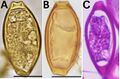 Eggs
Eggs -
 Life cycle
 -
 Egg
Egg -
 Male
Male -
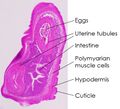 Whipworm on microscopy
 -
 Distribution


This WikiMD article can only be edited by registered and verified editors. You can log in or register.
| Parasitic disease caused by helminthiases | ||||
|---|---|---|---|---|
|

Medical Disclaimer: WikiMD is for informational purposes only and is not a substitute for professional medical advice. Content may be inaccurate or outdated and should not be used for diagnosis or treatment. Always consult your healthcare provider for medical decisions. Verify information with trusted sources such as CDC.gov and NIH.gov. By using this site, you agree that WikiMD is not liable for any outcomes related to its content. See full disclaimer.
Credits:Most images are courtesy of Wikimedia commons, and templates, categories Wikipedia, licensed under CC BY SA or similar.
Translate page: - East Asian
中文,
日本,
한국어,
South Asian
हिन्दी,
தமிழ்,
తెలుగు,
Urdu,
ಕನ್ನಡ,
Southeast Asian
Indonesian,
Vietnamese,
Thai,
မြန်မာဘာသာ,
বাংলা
European
español,
Deutsch,
français,
Greek,
português do Brasil,
polski,
română,
русский,
Nederlands,
norsk,
svenska,
suomi,
Italian
Middle Eastern & African
عربى,
Turkish,
Persian,
Hebrew,
Afrikaans,
isiZulu,
Kiswahili,
Other
Bulgarian,
Hungarian,
Czech,
Swedish,
മലയാളം,
मराठी,
ਪੰਜਾਬੀ,
ગુજરાતી,
Portuguese,
Ukrainian

