Anterior pituitary: Difference between revisions
CSV import Tags: mobile edit mobile web edit |
CSV import |
||
| Line 34: | Line 34: | ||
{{Endocrine system}} | {{Endocrine system}} | ||
{{Medicine-stub}} | {{Medicine-stub}} | ||
<gallery> | |||
File:Pituitary_Gland.png|Anterior pituitary | |||
File:1808_The_Anterior_Pituitary_Complex.jpg|Anterior pituitary | |||
File:Histology_of_pars_distalis_of_the_anterior_pituitary_with_chromophobes,_basophils,_and_acidophils,_annotated.jpg|Histology of pars distalis of the anterior pituitary | |||
File:Histology_of_anterior_pituitary_eosinophilic_follicles.jpg|Histology of anterior pituitary eosinophilic follicles | |||
File:Pituitary_gland_representation.PNG|Anterior pituitary | |||
File:Gray1180.png|Anterior pituitary | |||
File:Gray1181.png|Anterior pituitary | |||
</gallery> | |||
Revision as of 12:18, 18 February 2025
Anterior pituitary also known as the adenohypophysis, is a part of the pituitary gland, which is a small gland located at the base of the brain. The anterior pituitary is responsible for the production and release of several important hormones that regulate a wide range of bodily functions.
Structure
The anterior pituitary is located in the sella turcica, a small, bony cavity at the base of the brain. It is connected to the hypothalamus by a thin stalk known as the infundibulum. The anterior pituitary is composed of glandular tissue and is divided into three regions: the pars distalis, the pars intermedia, and the pars tuberalis.
Function
The anterior pituitary plays a crucial role in the endocrine system. It produces and releases a variety of hormones that regulate many bodily functions. These hormones include:
- Growth hormone (GH): Stimulates growth and cell reproduction in the body.
- Thyroid-stimulating hormone (TSH): Stimulates the thyroid gland to produce thyroid hormones.
- Adrenocorticotropic hormone (ACTH): Stimulates the adrenal glands to produce cortisol.
- Follicle-stimulating hormone (FSH) and Luteinizing hormone (LH): Regulate the function of the gonads in both males and females.
- Prolactin (PRL): Stimulates milk production in females after childbirth.
Regulation
The function of the anterior pituitary is regulated by the hypothalamus. The hypothalamus produces releasing hormones and inhibiting hormones that control the production and release of hormones from the anterior pituitary.
Clinical significance
Dysfunction of the anterior pituitary can lead to a variety of medical conditions. These include pituitary adenomas, hypopituitarism, and hyperpituitarism. Treatment for these conditions often involves medication, radiation therapy, or surgery.
See also
- Posterior pituitary
- Hypothalamic–pituitary–somatic axis
- Hypothalamic–pituitary–gonadal axis
- Hypothalamic–pituitary–adrenal axis
| Diseases of the endocrine system (E00–E35, 240–259) | ||||||||||||||||||||||||||||||||||||||
|---|---|---|---|---|---|---|---|---|---|---|---|---|---|---|---|---|---|---|---|---|---|---|---|---|---|---|---|---|---|---|---|---|---|---|---|---|---|---|
|

-
 Anterior pituitary
 -
 Anterior pituitary
 -
 Histology of pars distalis of the anterior pituitary
 -
 Histology of anterior pituitary eosinophilic follicles
 -
 Anterior pituitary
 -
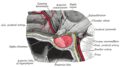 Anterior pituitary
 -
 Anterior pituitary


