Lithium (medication): Difference between revisions
No edit summary |
CSV import |
||
| Line 67: | Line 67: | ||
[[Category:Mood stabilizers]] | [[Category:Mood stabilizers]] | ||
[[Category:Nephrotoxins]] | [[Category:Nephrotoxins]] | ||
<gallery> | |||
File:Lithium-carbonate2DCSD.svg|Structural formula of lithium carbonate | |||
File:Lithium-carbonate-xtal-1979-Mercury-3D-sf.png|3D model of lithium carbonate crystal structure | |||
File:Lithium300mg.jpg|Lithium 300 mg tablets | |||
</gallery> | |||
Revision as of 03:51, 18 February 2025
Lithium compounds, also known as lithium salts, are primarily used as psychiatric medications. They are most commonly used to treat bipolar disorder and major depressive disorder that does not improve following the use of antidepressants. Lithium is known to reduce the risk of suicide in these disorders and is administered orally.
Pharmacology
Lithium is classified as a mood stabilizer and has a unique mechanism of action in comparison to other psychiatric medications. While the exact mechanism is not fully understood, it is believed to affect various neurotransmitter systems, such as dopamine, serotonin, and glutamate, to stabilize mood fluctuations. Lithium also influences second messenger systems, including the inositol phosphate system and the protein kinase C pathway, which may contribute to its therapeutic effects.
Indications
Lithium is primarily prescribed for the following conditions:
- Bipolar disorder: Lithium is used in the treatment of both manic and depressive episodes, as well as for the maintenance treatment to prevent relapse.
- Major depressive disorder: In cases where patients do not respond to antidepressants, lithium may be used as an adjunctive therapy to enhance the effects of other medications.
Side Effects
Lithium may cause a range of side effects, which can vary in severity. Some common side effects include:
- Nausea and vomiting
- Diarrhea
- Tremors
- Increased thirst and urination
- Weight gain
- Cognitive impairment
Serious side effects may include:
- Kidney dysfunction
- Thyroid dysfunction
- Low blood sodium levels (hyponatremia)
- Lithium toxicity
Patients taking lithium should be closely monitored by their healthcare provider, with regular blood tests to assess lithium levels, kidney function, and thyroid function.
Contraindications
Lithium is contraindicated in patients with severe kidney impairment, severe heart disease, or low blood sodium levels. It should also be used with caution in pregnant and breastfeeding women, as lithium can cross the placenta and be excreted in breast milk.
Drug Interactions
Lithium may interact with several other medications, including:
- Diuretics
- Nonsteroidal anti-inflammatory drugs (NSAIDs)
- Angiotensin-converting enzyme (ACE) inhibitors
- Antidepressants
These interactions may alter lithium levels in the body and increase the risk of side effects or reduce the drug's effectiveness. It is essential to inform the healthcare provider of all medications being taken while on lithium therapy.
References
<references> Bauer M, Gitlin M,
 The essential guide to lithium treatment,
 International Journal of Bipolar Disorders,
 2016,
 Vol. 4(Issue: 1),
 pp. 11,
 DOI: 10.1186/s40345-016-0055-5,
 PMID: 27068515,
Malhi GS, Tanious M, Das P, et al.,
 The science and practice of lithium therapy,
 Australian & New Zealand Journal of Psychiatry,
 2012,
 Vol. 46(Issue: 3),
 pp. 192–211,
 DOI: 10.1177/0004867412437346,
 PMID: 22391270,
Geddes JR, Miklowitz DJ,
 Treatment of bipolar disorder,
 Lancet,
 2013,
 Vol. 381(Issue: 9878),
 pp. 1672–1682,
 DOI: 10.1016/S0140-6736(13)60857-0,
 PMID: 23663953,
Nelson JC, Baumann P, Delucchi K, et al.,
 A systematic review and meta-analysis of lithium augmentation of tricyclic and second generation antidepressants in major depression,
 Journal of Affective Disorders,
 2014,
 Vol. 168,
 pp. 269–275,
 DOI: 10.1016/j.jad.2014.07.013,
 PMID: 25128859,
</references>
External Links
Summary
Lithium compounds, also known as lithium salts, are primarily used as a, psychiatric, medication. They are primarily used to treat bipolar disorder and treat major depressive disorder that does not improve following the use of antidepressants. In these disorders, it reduces the risk of suicide. Lithium is taken orally.
 | |
|---|---|
 |
 |
| Mood stabilizers | ||||||
|---|---|---|---|---|---|---|
|
| Oxytocin and vasopressin receptor modulators | ||||||||||||||||
|---|---|---|---|---|---|---|---|---|---|---|---|---|---|---|---|---|
|
| Elements in biology | ||||||||
|---|---|---|---|---|---|---|---|---|
|
-
 Structural formula of lithium carbonate
 -
 3D model of lithium carbonate crystal structure
 -
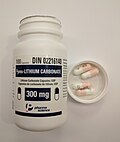 Lithium 300 mg tablets


