Puromycin
Puromycin is an aminonucleoside antibiotic, derived from the Streptomyces alboniger bacterium, that causes premature chain termination during translation taking place in the ribosome. In molecular biology, puromycin is used in laboratories, among other things, to study protein synthesis.
Structure and properties[edit]
Puromycin is structurally similar to aminoacyl tRNA. It is taken up in the A site of the ribosome during translation, causes premature chain termination by acting as an analog of the 3'-end of tyrosyl tRNA. This property leads to the incorporation of puromycin into the nascent chain and the subsequent release of the polypeptide.
Uses[edit]
In molecular biology, puromycin is used to study protein synthesis. By incorporating itself into the growing protein chain, the formation of long proteins is prevented, allowing the study of their synthesis. Puromycin is also used as a selective agent in laboratory cultures. It kills all cells that have not been transformed with a resistance gene (pac gene).
Resistance[edit]
Resistance to puromycin is conferred by the pac gene, encoding a puromycin N-acetyl-transferase (PAC) that was found in a Streptomyces producer strain. This enzyme inactivates puromycin by transferring an acetyl group from acetyl coenzyme A to the primary amine of puromycin.
See also[edit]
- Aminonucleoside
- Antibiotic
- Streptomyces alboniger
- Translation (biology)
- Ribosome
- Aminoacyl tRNA
- Tyrosyl tRNA
- Molecular biology
- Protein synthesis
- Pac gene
- Puromycin N-acetyl-transferase

This WikiMD article can only be edited by registered and verified editors. You can log in or register.
Puromycin[edit]
-
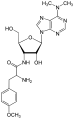 Puromycin skeletal structure
 -
 Puromycin 3D spacefill model


Advertise on WikiMD — 81,000+ full articles, ~900,000 total pages, ~250 million page views. Global reach, limited time promotional rates from $1/page/day. Learn more · View stats

Translate page: - East Asian
中文,
日本,
한국어,
South Asian
हिन्दी,
தமிழ்,
తెలుగు,
Urdu,
ಕನ್ನಡ,
Southeast Asian
Indonesian,
Vietnamese,
Thai,
မြန်မာဘာသာ,
বাংলা
European
español,
Deutsch,
français,
Greek,
português do Brasil,
polski,
română,
русский,
Nederlands,
norsk,
svenska,
suomi,
Italian
Middle Eastern & African
عربى,
Turkish,
Persian,
Hebrew,
Afrikaans,
isiZulu,
Kiswahili,
Other
Bulgarian,
Hungarian,
Czech,
Swedish,
മലയാളം,
मराठी,
ਪੰਜਾਬੀ,
ગુજરાતી,
Portuguese,
Ukrainian
About WikiMD • Contact • Disclaimer • Privacy • Copyright • Site statistics
Some content and images may originate from Wikimedia Commons or Wikipedia and remain subject to their stated licenses. Unless otherwise noted, eligible WikiMD content is available under CC BY-SA 4.0.
WikiMD Wellnesspedia — Free health & wellness information for patients, students, and health professionals.

