N-Butyllithium
N-Butyllithium (n-BuLi) is an organolithium reagent used in synthetic chemistry. It is a colorless or light yellow solution when dissolved in hydrocarbon solvents such as hexane or heptane. N-Butyllithium is highly reactive and functions as a strong base and nucleophile in organic synthesis. It is commonly used for the deprotonation of acidic hydrogen atoms in organic molecules, allowing for the formation of carbon-lithium bonds and subsequent nucleophilic addition reactions.
Properties[edit]
N-Butyllithium exists as a cluster in solution and in the solid state, a characteristic common to many organolithium compounds. It is extremely pyrophoric and reacts violently with water, producing butane and lithium hydroxide. Due to its high reactivity, n-BuLi must be handled under an inert atmosphere in a dry solvent.
Synthesis[edit]
N-Butyllithium is typically synthesized by the reaction of butyl chloride with lithium metal in a hydrocarbon solvent. This process involves a two-phase reaction, where the lithium metal is dissolved in a non-polar solvent and reacts with the butyl chloride to produce n-BuLi and lithium chloride (LiCl) as a by-product.
Applications[edit]
N-Butyllithium is widely used in organic synthesis for various applications:
- Deprotonation: It is employed to deprotonate acidic protons from molecules, generating carbanions which can act as nucleophiles.
- Anionic polymerization: n-BuLi serves as an initiator for the anionic polymerization of dienes, such as butadiene and isoprene, leading to the production of synthetic rubbers.
- Halogen-Lithium exchange: It is used in halogen-lithium exchange reactions, which are useful for the synthesis of organolithium compounds from organic halides.
- Metalation: The reagent can effect metalation, where a hydrogen atom is replaced by a lithium atom, facilitating further functionalization of the molecule.
Safety[edit]
Due to its strong reactivity, especially with water and air, n-BuLi must be handled with extreme caution. Appropriate safety measures, including the use of an inert atmosphere and dry solvents, are essential to prevent uncontrolled reactions.
See Also[edit]

N-Butyllithium[edit]
-
 Butyllithium hexamer 3D balls
 -
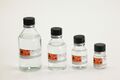 Glass bottles containing Butyllithium


Medical Disclaimer: WikiMD is for informational purposes only and is not a substitute for professional medical advice. Content may be inaccurate or outdated and should not be used for diagnosis or treatment. Always consult your healthcare provider for medical decisions. Verify information with trusted sources such as CDC.gov and NIH.gov. By using this site, you agree that WikiMD is not liable for any outcomes related to its content. See full disclaimer.
Credits:Most images are courtesy of Wikimedia commons, and templates, categories Wikipedia, licensed under CC BY SA or similar.
Translate page: - East Asian
中文,
日本,
한국어,
South Asian
हिन्दी,
தமிழ்,
తెలుగు,
Urdu,
ಕನ್ನಡ,
Southeast Asian
Indonesian,
Vietnamese,
Thai,
မြန်မာဘာသာ,
বাংলা
European
español,
Deutsch,
français,
Greek,
português do Brasil,
polski,
română,
русский,
Nederlands,
norsk,
svenska,
suomi,
Italian
Middle Eastern & African
عربى,
Turkish,
Persian,
Hebrew,
Afrikaans,
isiZulu,
Kiswahili,
Other
Bulgarian,
Hungarian,
Czech,
Swedish,
മലയാളം,
मराठी,
ਪੰਜਾਬੀ,
ગુજરાતી,
Portuguese,
Ukrainian

