Roti canai
Roti canai is a type of Indian-influenced flatbread found in Malaysia, Brunei, Indonesia and Singapore. It is often referred to as "flying bread," a term that evokes the process of tossing and spinning by which it is made.
History[edit]
The origins of roti canai can be traced back to the Indian community in Malaysia. It is believed to have been introduced by Indian immigrants to the country. The term "canai" comes from "channa", a mixture of boiled chickpeas in a spicy gravy from North India which it was traditionally served with.
Preparation[edit]
The preparation of roti canai involves multiple stages. The dough is made from flour, water, and ghee (clarified butter). It is kneaded, flattened, oiled, and folded repeatedly, then allowed to proof and rise. The dough is then stretched with a process of tossing and spinning until it becomes a very thin sheet. It is then folded into a circular shape, and cooked on a flat iron skillet with plenty of oil.
Serving[edit]
Roti canai is traditionally served with dhal (lentil curry), but can also be eaten with other types of curry, or even on its own. In recent years, variations of roti canai have emerged, with fillings such as egg, onion, sardines, and even sweet fillings like banana or chocolate.
Cultural Significance[edit]
Roti canai is a popular breakfast and snack dish in Malaysia and is an integral part of the country's cuisine. It is also commonly found in areas with a significant Indian-Malaysian diaspora, such as Australia and Canada.
See Also[edit]

|
This article is part of the series on |
 |
|
Regional cuisines |
East India West India Northeast India Other |
|
Ingredients and types of food |
|
Preparation and cooking |
|
See also |
|
Related cuisines |
|
|

-
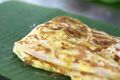 Canai
Canai -
 Roticanai bukittinggi
 -
 Roti canai 2
 -
 Roti Tisu
 -
 Roti sardin
 -
 Roti Prata Curry
 -
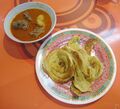 Roti Cane Kari Kambing Aceh
 -
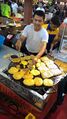 Martabak Kubang


Medical Disclaimer: WikiMD is for informational purposes only and is not a substitute for professional medical advice. Content may be inaccurate or outdated and should not be used for diagnosis or treatment. Always consult your healthcare provider for medical decisions. Verify information with trusted sources such as CDC.gov and NIH.gov. By using this site, you agree that WikiMD is not liable for any outcomes related to its content. See full disclaimer.
Credits:Most images are courtesy of Wikimedia commons, and templates, categories Wikipedia, licensed under CC BY SA or similar.
Translate page: - East Asian
中文,
日本,
한국어,
South Asian
हिन्दी,
தமிழ்,
తెలుగు,
Urdu,
ಕನ್ನಡ,
Southeast Asian
Indonesian,
Vietnamese,
Thai,
မြန်မာဘာသာ,
বাংলা
European
español,
Deutsch,
français,
Greek,
português do Brasil,
polski,
română,
русский,
Nederlands,
norsk,
svenska,
suomi,
Italian
Middle Eastern & African
عربى,
Turkish,
Persian,
Hebrew,
Afrikaans,
isiZulu,
Kiswahili,
Other
Bulgarian,
Hungarian,
Czech,
Swedish,
മലയാളം,
मराठी,
ਪੰਜਾਬੀ,
ગુજરાતી,
Portuguese,
Ukrainian

