Ikan goreng
Ikan goreng is a generic term for various dishes of Indonesian, Malaysian, and Bruneian cuisines, denoting a method of cooking fish. The fish is often marinated with a mixture of spices pastes, and then fried. The dish is a staple part of the diet in these countries due to the rich fishing in the area that provides a wide variety of seafood.
Etymology[edit]
The term "Ikan goreng" comes from the Indonesian and Malay words, where "Ikan" means fish and "goreng" means fried.
Preparation[edit]
The preparation of Ikan goreng involves marinating the fish in a mixture of spices and then frying it. The marinade typically includes ingredients such as turmeric, garlic, shallots, tamarind, and chili peppers. The fish is then deep-fried in coconut oil until it is crispy. The dish is usually served with rice, sambal, and a variety of vegetables.
Varieties[edit]
There are many varieties of Ikan goreng, depending on the type of fish used and the specific spices included in the marinade. Some popular types include Ikan goreng Javanese style, which uses a sweet soy sauce and is served with raw vegetables, and Ikan goreng Balinese style, which uses a spicy sambal.
Cultural significance[edit]
Ikan goreng is a staple dish in Indonesian, Malaysian, and Bruneian cuisines. It is commonly served at home, in restaurants, and at street food stalls. The dish is also often included in festive and ceremonial occasions.
See also[edit]

This Malaysia-food related article is a stub. You can help WikiMD by expanding it.
-
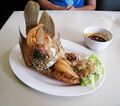 Gurame Goreng Kipas
 -
 Ikan Goreng Kunyit
 -
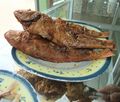 Goreng Ikan Merah Palopo


Ikan_goreng[edit]

Medical Disclaimer: WikiMD is for informational purposes only and is not a substitute for professional medical advice. Content may be inaccurate or outdated and should not be used for diagnosis or treatment. Always consult your healthcare provider for medical decisions. Verify information with trusted sources such as CDC.gov and NIH.gov. By using this site, you agree that WikiMD is not liable for any outcomes related to its content. See full disclaimer.
Credits:Most images are courtesy of Wikimedia commons, and templates, categories Wikipedia, licensed under CC BY SA or similar.
Translate page: - East Asian
中文,
日本,
한국어,
South Asian
हिन्दी,
தமிழ்,
తెలుగు,
Urdu,
ಕನ್ನಡ,
Southeast Asian
Indonesian,
Vietnamese,
Thai,
မြန်မာဘာသာ,
বাংলা
European
español,
Deutsch,
français,
Greek,
português do Brasil,
polski,
română,
русский,
Nederlands,
norsk,
svenska,
suomi,
Italian
Middle Eastern & African
عربى,
Turkish,
Persian,
Hebrew,
Afrikaans,
isiZulu,
Kiswahili,
Other
Bulgarian,
Hungarian,
Czech,
Swedish,
മലയാളം,
मराठी,
ਪੰਜਾਬੀ,
ગુજરાતી,
Portuguese,
Ukrainian

