Zongzi
Zongzi is a traditional Chinese food, made of glutinous rice stuffed with different fillings and wrapped in bamboo, reed, or other large flat leaves. They are cooked by steaming or boiling. In the Western world, they are also known as rice dumplings or sticky rice dumplings.
History[edit]
The origin of Zongzi is said to be traced back to the Spring and Autumn period in ancient China. They are traditionally eaten during the Duanwu Festival which falls on the fifth day of the fifth month of the lunar calendar (approximately late-May to mid-June).
Preparation[edit]
The making of Zongzi is a family event of which everyone takes part. Glutinous rice is used as the main ingredient along with many others such as beans, lotus seeds, chestnuts, pork fat and the golden yolk of a salted duck egg. The ingredients used for the fillings vary across different regions in China. The leaves used for the wrapping are often soaked in water and then boiled until they become soft and pliable. The rice and the fillings are then wrapped into the leaves, which are then bound with a kind of raffia.
Varieties[edit]
There are many different varieties of Zongzi, due to the wide array of fillings that can be used. Some of the most popular ones include:
- Jianshui Zong (Alkaline Zongzi): This is a sweet version of Zongzi. It is made using alkaline treated rice and filled with red bean paste. The rice turns yellow and the texture is softer than regular Zongzi.
- Nyonya Zong: This is a specialty of the Peranakan Chinese in Malaysia and Singapore. The glutinous rice is usually dyed blue with butterfly pea flowers and is filled with candied winter melon, pork belly, ground roasted peanuts, and a spice mix.
- Jiaxing Zongzi: Named after Jiaxing, a city in Zhejiang province, this variety is filled with pork and salted duck egg yolk.
Cultural Significance[edit]
Zongzi is traditionally eaten during the Duanwu Festival in remembrance of Qu Yuan, a famous Chinese poet from the kingdom of Chu who lived during the Warring States period. According to folklore, packets of rice were thrown into the river to prevent the fish from eating the poet's body after he drowned himself in the Miluo River.

-
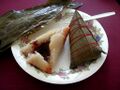 Zongzi
 -
Zongzi being made in Hainan, China
-
Zongzi leaves
-
Zongzi from Cheung Kee Sun Sum Yeung Nam For in Hong Kong
-
Two Zongzi styles
-
Two Zongzi styles, inside
-
China Northwestern Style Zongzi
-
Nyonya Zongzi
-
Lady makes zongzi in Zhujiajiao, Shanghai
-
Yellow Zongzi
-
Zongzi
-
A Zongzi of Great from Nam Long Congee Shop

Sponsored Health Resource

W8MD Weight Loss, Sleep & MedSpa
Looking for physician-supervised weight loss, semaglutide, tirzepatide, or GLP-1 receptor agonist options? W8MD helps eligible patients in New York City, Brooklyn, New Jersey, Connecticut, Pennsylvania, Delaware, and greater Philadelphia with medical weight loss, sleep medicine, and long-term maintenance support.
GLP-1 specials: Affordable GLP-1 injections NYC and Philadelphia starting from $29.99/week and up for semaglutide with insurance accepted for qualifying visits, and $45/week and up for tirzepatide with insurance accepted for qualifying visits. Self-pay options start from $59.99/week and up for semaglutide and $69.99/week and up for tirzepatide.
Medical weight loss NYC | Affordable GLP-1 injections NYC | Budget GLP-1 weight loss shots Philadelphia | New Jersey medical weight loss | NYC medical weight loss | Philadelphia medical weight loss | Sleep clinic NYC | W8MD's Philadelphia GLP-1 doctor | Weight loss prescriptions NYC
Book a W8MD appointment · View GLP-1 specials
Paid promotional message. Eligibility, pricing, insurance coverage, medication availability, and results vary. Medical evaluation required.

Medical Disclaimer: WikiMD is for informational purposes only and is not a substitute for professional medical advice. Content may be inaccurate or outdated and should not be used for diagnosis or treatment. Always consult your healthcare provider for medical decisions. Verify information with trusted sources such as CDC.gov and NIH.gov. By using this site, you agree that WikiMD is not liable for any outcomes related to its content. See full disclaimer.
Credits:Most images are courtesy of Wikimedia commons, and templates, categories Wikipedia, licensed under CC BY SA or similar.
Translate page: - East Asian
中文,
日本,
한국어,
South Asian
हिन्दी,
தமிழ்,
తెలుగు,
Urdu,
ಕನ್ನಡ,
Southeast Asian
Indonesian,
Vietnamese,
Thai,
မြန်မာဘာသာ,
বাংলা
European
español,
Deutsch,
français,
Greek,
português do Brasil,
polski,
română,
русский,
Nederlands,
norsk,
svenska,
suomi,
Italian
Middle Eastern & African
عربى,
Turkish,
Persian,
Hebrew,
Afrikaans,
isiZulu,
Kiswahili,
Other
Bulgarian,
Hungarian,
Czech,
Swedish,
മലയാളം,
मराठी,
ਪੰਜਾਬੀ,
ગુજરાતી,
Portuguese,
Ukrainian


.jpg)
