Ketupat
Ketupat is a type of rice dumpling from the Southeast Asian region, traditionally associated with the Indonesian, Malaysian, Bruneian, Filipino, and Singaporean cuisines. It is a popular food item during festive occasions such as Eid al-Fitr and Eid al-Adha.
Overview[edit]
Ketupat is made from rice that has been wrapped in a woven palm leaf pouch before boiling. As the rice cooks, it expands to fill the pouch and the rice becomes compressed. This method of cooking gives the ketupat its characteristic form and texture of a rice dumpling.
Ketupat is commonly used as an accompaniment to rendang, a spicy meat dish, and satay, a grilled skewered meat. It is also traditionally served as part of the festive meals during Muslim celebrations in Southeast Asia.
Cultural Significance[edit]
In many Southeast Asian cultures, ketupat is a symbol of celebration and gratitude. It is often used as a festive dish during celebrations such as Eid al-Fitr, which marks the end of Ramadan, the Islamic holy month of fasting. The diamond shape of ketupat is also said to symbolize a purified heart, which is an important aspect of Eid celebrations.
Varieties[edit]
There are several varieties of ketupat, with two of the most common being ketupat nasi and ketupat pulut. Ketupat nasi is made from white rice and is the most common variety. Ketupat pulut, also known as "glutinous rice ketupat", is made from glutinous rice and is often used in desserts.
Preparation[edit]
The preparation of ketupat involves the packing of partially cooked rice into a woven pouch made from palm leaves, which is then boiled. The weaving process for the pouch is intricate and requires skill. The rice used can be regular white rice or glutinous rice, depending on the variety of ketupat being made.
See Also[edit]

-
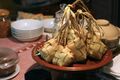 Ketupat


Medical Disclaimer: WikiMD is for informational purposes only and is not a substitute for professional medical advice. Content may be inaccurate or outdated and should not be used for diagnosis or treatment. Always consult your healthcare provider for medical decisions. Verify information with trusted sources such as CDC.gov and NIH.gov. By using this site, you agree that WikiMD is not liable for any outcomes related to its content. See full disclaimer.
Credits:Most images are courtesy of Wikimedia commons, and templates, categories Wikipedia, licensed under CC BY SA or similar.
Translate page: - East Asian
中文,
日本,
한국어,
South Asian
हिन्दी,
தமிழ்,
తెలుగు,
Urdu,
ಕನ್ನಡ,
Southeast Asian
Indonesian,
Vietnamese,
Thai,
မြန်မာဘာသာ,
বাংলা
European
español,
Deutsch,
français,
Greek,
português do Brasil,
polski,
română,
русский,
Nederlands,
norsk,
svenska,
suomi,
Italian
Middle Eastern & African
عربى,
Turkish,
Persian,
Hebrew,
Afrikaans,
isiZulu,
Kiswahili,
Other
Bulgarian,
Hungarian,
Czech,
Swedish,
മലയാളം,
मराठी,
ਪੰਜਾਬੀ,
ગુજરાતી,
Portuguese,
Ukrainian

