Ayam buah keluak
Ayam buah keluak is a traditional dish originating from the Peranakan culture, which is a blend of Chinese and Malay/Indonesian cultures in Southeast Asia. The dish is particularly popular in Malaysia and Singapore.
Ingredients[edit]
The main ingredients of Ayam buah keluak are chicken (ayam in Malay) and the seeds of the buah keluak (Pangium edule), also known as the kepayang tree or the football fruit. The seeds are poisonous in their raw state and must be prepared properly to remove the toxins. Other ingredients typically include tamarind, turmeric, lemongrass, chili peppers, and belacan (shrimp paste).
Preparation[edit]
The preparation of Ayam buah keluak is time-consuming and requires several steps. The buah keluak seeds are first soaked in water for several days, then boiled, and finally buried in ash for more than a month to ferment. The seeds are then cracked open and the insides are scooped out and mixed with spices to form a paste. This paste is stuffed back into the seeds, which are then cooked with the chicken and other ingredients.
Cultural Significance[edit]
Ayam buah keluak is considered a signature dish of Peranakan cuisine, also known as Nyonya cuisine. It is often served at special occasions and celebrations. Despite its labor-intensive preparation, it is highly valued for its unique flavor and the skill required to prepare it.
See Also[edit]

-
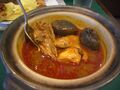 Ayam_buah_keluak


Medical Disclaimer: WikiMD is for informational purposes only and is not a substitute for professional medical advice. Content may be inaccurate or outdated and should not be used for diagnosis or treatment. Always consult your healthcare provider for medical decisions. Verify information with trusted sources such as CDC.gov and NIH.gov. By using this site, you agree that WikiMD is not liable for any outcomes related to its content. See full disclaimer.
Credits:Most images are courtesy of Wikimedia commons, and templates, categories Wikipedia, licensed under CC BY SA or similar.
Translate page: - East Asian
中文,
日本,
한국어,
South Asian
हिन्दी,
தமிழ்,
తెలుగు,
Urdu,
ಕನ್ನಡ,
Southeast Asian
Indonesian,
Vietnamese,
Thai,
မြန်မာဘာသာ,
বাংলা
European
español,
Deutsch,
français,
Greek,
português do Brasil,
polski,
română,
русский,
Nederlands,
norsk,
svenska,
suomi,
Italian
Middle Eastern & African
عربى,
Turkish,
Persian,
Hebrew,
Afrikaans,
isiZulu,
Kiswahili,
Other
Bulgarian,
Hungarian,
Czech,
Swedish,
മലയാളം,
मराठी,
ਪੰਜਾਬੀ,
ગુજરાતી,
Portuguese,
Ukrainian

