Superior vestibular nucleus: Difference between revisions
CSV import Tags: mobile edit mobile web edit |
CSV import |
||
| Line 48: | Line 48: | ||
[[Category:Neuroanatomy]] | [[Category:Neuroanatomy]] | ||
[[Category:Brainstem]] | [[Category:Brainstem]] | ||
==Superior vestibular nucleus== | |||
<gallery> | |||
File:Gray761.png|Gray761 | |||
</gallery> | |||
Latest revision as of 21:04, 23 February 2025
| General Information | |
|---|---|
| Latin | nucleus vestibularis superior |
| Greek | |
| TA98 | |
| TA2 | |
| FMA | |
| Details | |
| System | Vestibular system |
| Artery | Anterior inferior cerebellar artery |
| Vein | |
| Nerve | Vestibulocochlear nerve |
| Lymphatic drainage | |
| Precursor | |
| Function | |
| Identifiers | |
| Clinical significance | |
| Notes | |
The superior vestibular nucleus is one of the four major vestibular nuclei located in the brainstem. It plays a crucial role in the processing of vestibular information and is involved in the coordination of eye movements and posture.
Anatomy[edit]
The superior vestibular nucleus is situated in the pons, a part of the brainstem. It is located dorsally to the medial vestibular nucleus and is adjacent to the lateral vestibular nucleus. The superior vestibular nucleus is part of the vestibular nuclear complex, which also includes the inferior vestibular nucleus.
Connections[edit]
The superior vestibular nucleus receives input from the semicircular canals of the inner ear via the vestibular nerve, a branch of the vestibulocochlear nerve (CN VIII). It also receives input from the cerebellum, particularly the flocculonodular lobe, which is involved in the integration of vestibular information.
The superior vestibular nucleus sends efferent projections to several key areas:
- The oculomotor nucleus and trochlear nucleus, which are involved in the control of eye movements.
- The thalamus, which relays vestibular information to the cerebral cortex.
- The spinal cord, where it influences postural reflexes.
Function[edit]
The primary function of the superior vestibular nucleus is to process and integrate sensory information from the vestibular apparatus. This information is crucial for maintaining balance, spatial orientation, and gaze stabilization.
Gaze Stabilization[edit]
The superior vestibular nucleus is involved in the vestibulo-ocular reflex (VOR), which stabilizes vision during head movements by producing compensatory eye movements. This reflex is essential for clear vision while the head is in motion.
Postural Control[edit]
Through its connections with the spinal cord, the superior vestibular nucleus helps regulate muscle tone and posture, allowing the body to maintain balance and equilibrium.
Clinical Significance[edit]
Dysfunction of the superior vestibular nucleus can lead to a variety of clinical symptoms, including vertigo, nystagmus, and balance disorders. Lesions affecting this nucleus may result from stroke, multiple sclerosis, or other neurological conditions.
See Also[edit]
| Anatomy and morphology | ||||||||||
|---|---|---|---|---|---|---|---|---|---|---|
|
Superior vestibular nucleus[edit]
-
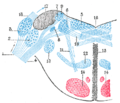 Gray761

