Decapod anatomy
Decapod anatomy refers to the physical structure and characteristics of decapods, a large order of crustaceans that includes species such as crabs, lobsters, and shrimp.
Overview[edit]
Decapods are characterized by their ten legs or "decapod" structure. This is a defining feature of the order and is a key aspect of their anatomy. The body of a decapod is typically divided into two main sections: the cephalothorax (head and thorax combined) and the abdomen.
Cephalothorax[edit]
The cephalothorax is the front part of a decapod's body. It is covered by a single exoskeleton piece known as the carapace, which provides protection. The cephalothorax contains the head and thorax, which are fused together. The head region houses the eyes, antennae, and mouthparts, while the thorax contains the legs and gills.
Abdomen[edit]
The abdomen is the rear part of a decapod's body. It is segmented and flexible, allowing for movement. The abdomen houses the reproductive organs and the tail, which ends in a fan-like structure in many species. This tail can be used for rapid backwards movement in the water, especially in shrimp and lobsters.
Legs[edit]
Decapods have ten legs, which are used for various functions depending on the species. In crabs, the first pair of legs is often modified into claws for defense and feeding. In lobsters and shrimp, the legs are primarily used for locomotion and manipulating food.
Gills[edit]
Decapods breathe through gills, which are located in the thoracic region. Water flows over the gills, allowing oxygen to be extracted and carbon dioxide to be expelled.
Reproduction[edit]
Decapods have separate sexes and most species reproduce sexually. The female carries the eggs until they hatch, often attached to the underside of the abdomen.
See also[edit]
 | This arthropod-related article is a stub. You can help WikiMD by expanding the page. |
-
 Diagram of Penaeus antennae
 -
 Diagram of Penaeus pereiopods
 -
 Diagram of Penaeus carapace
 -
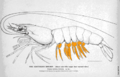 Diagram of Penaeus pleopods
 -
 Diagram of Penaeus telson
 -
 Crab tail anatomy
 -
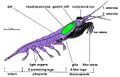 Krill anatomy
 -
 Pleopods of Euphausia superba
 -
 Crab internal anatomy


Medical Disclaimer: WikiMD is for informational purposes only and is not a substitute for professional medical advice. Content may be inaccurate or outdated and should not be used for diagnosis or treatment. Always consult your healthcare provider for medical decisions. Verify information with trusted sources such as CDC.gov and NIH.gov. By using this site, you agree that WikiMD is not liable for any outcomes related to its content. See full disclaimer.
Credits:Most images are courtesy of Wikimedia commons, and templates, categories Wikipedia, licensed under CC BY SA or similar.
Translate page: - East Asian
中文,
日本,
한국어,
South Asian
हिन्दी,
தமிழ்,
తెలుగు,
Urdu,
ಕನ್ನಡ,
Southeast Asian
Indonesian,
Vietnamese,
Thai,
မြန်မာဘာသာ,
বাংলা
European
español,
Deutsch,
français,
Greek,
português do Brasil,
polski,
română,
русский,
Nederlands,
norsk,
svenska,
suomi,
Italian
Middle Eastern & African
عربى,
Turkish,
Persian,
Hebrew,
Afrikaans,
isiZulu,
Kiswahili,
Other
Bulgarian,
Hungarian,
Czech,
Swedish,
മലയാളം,
मराठी,
ਪੰਜਾਬੀ,
ગુજરાતી,
Portuguese,
Ukrainian

