Pons
The Pons is a part of the brainstem that links the medulla oblongata and the thalamus. The pons contains nuclei that relay signals from the forebrain to the cerebellum, along with nuclei that deal primarily with sleep, respiration, swallowing, bladder control, hearing, equilibrium, taste, eye movement, facial expressions, facial sensation, and posture.
Structure[edit]
The pons is in the brainstem, and it sits above the medulla oblongata and below the midbrain. It is anterior to the cerebellum. The pons contains pathways or tracts that relay signals from the brain down to the cerebellum and medulla, and tracts that carry the sensory signals up into the thalamus.
Function[edit]
The main function of the pons is to serve as a bridge between various parts of the nervous system, including the cerebellum and cerebrum. In addition, the pons helps to regulate breathing and control the functions of the autonomic nervous system. It also relays sensory information between the cerebrum and cerebellum.
Clinical significance[edit]
Damage to the pons can lead to a number of neurological problems. For example, lesions in the pons can lead to Locked-in syndrome, a condition in which individuals can only move their eyes and are conscious but cannot move or communicate verbally due to complete paralysis of nearly all voluntary muscles in the body except for the eyes.
See also[edit]
References[edit]
External links[edit]

This WikiMD article can only be edited by registered and verified editors. You can log in or register.
Pons[edit]
-
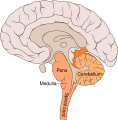 Diagram of the brain bulbar region
 -
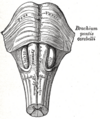 Gray's Anatomy illustration of the pons
 -
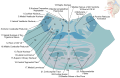 Horizontal section of the lower pons
 -
 Animated image of the pons
 -
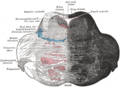 Gray's Anatomy illustration of the brainstem
 -
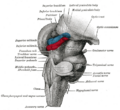 Gray's Anatomy illustration of the pons and medulla oblongata
 -
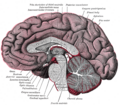 Gray's Anatomy illustration of the pons and cerebellum
 -
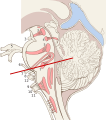 Sagittal section of the brain stem
 -
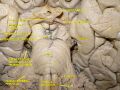 Photograph of a brain section showing the pons


Medical Disclaimer: WikiMD is for informational purposes only and is not a substitute for professional medical advice. Content may be inaccurate or outdated and should not be used for diagnosis or treatment. Always consult your healthcare provider for medical decisions. Verify information with trusted sources such as CDC.gov and NIH.gov. By using this site, you agree that WikiMD is not liable for any outcomes related to its content. See full disclaimer.
Credits:Most images are courtesy of Wikimedia commons, and templates, categories Wikipedia, licensed under CC BY SA or similar.
Translate page: - East Asian
中文,
日本,
한국어,
South Asian
हिन्दी,
தமிழ்,
తెలుగు,
Urdu,
ಕನ್ನಡ,
Southeast Asian
Indonesian,
Vietnamese,
Thai,
မြန်မာဘာသာ,
বাংলা
European
español,
Deutsch,
français,
Greek,
português do Brasil,
polski,
română,
русский,
Nederlands,
norsk,
svenska,
suomi,
Italian
Middle Eastern & African
عربى,
Turkish,
Persian,
Hebrew,
Afrikaans,
isiZulu,
Kiswahili,
Other
Bulgarian,
Hungarian,
Czech,
Swedish,
മലയാളം,
मराठी,
ਪੰਜਾਬੀ,
ગુજરાતી,
Portuguese,
Ukrainian

