Naem (food): Difference between revisions
CSV import Tags: mobile edit mobile web edit |
No edit summary |
||
| (One intermediate revision by the same user not shown) | |||
| Line 1: | Line 1: | ||
[[File:Naem_khluk.jpg|Naem khluk|thumb]] | |||
[[File:Lao_Som_moo_(combined-17.jpg).jpg|Lao Som moo|thumb]] | |||
[[File:Chin_som_mok.JPG|Chin som mok|thumb]] | |||
Naem is a traditional fermented sausage originating from [[Southeast Asia]]. It is a popular dish in countries such as [[Thailand]], [[Laos]], and [[Vietnam]]. | Naem is a traditional fermented sausage originating from [[Southeast Asia]]. It is a popular dish in countries such as [[Thailand]], [[Laos]], and [[Vietnam]]. | ||
| Line 21: | Line 19: | ||
Despite its high fat content, Naem is rich in [[protein]] and contains beneficial [[probiotics]] due to the fermentation process. However, it should be consumed in moderation due to its high sodium content. | Despite its high fat content, Naem is rich in [[protein]] and contains beneficial [[probiotics]] due to the fermentation process. However, it should be consumed in moderation due to its high sodium content. | ||
== Naem (food) gallery == | |||
<gallery> | |||
File:Khua_chin_som_sai_khai.JPG|Khua chin som sai khai | |||
File:Yam_naem.JPG|Yam naem | |||
File:Phat_naem_sai_khai.jpg|Phat naem sai khai | |||
</gallery> | |||
=== See Also === | === See Also === | ||
| Line 28: | Line 33: | ||
* [[Cuisine of Laos]] | * [[Cuisine of Laos]] | ||
* [[Cuisine of Vietnam]] | * [[Cuisine of Vietnam]] | ||
{{Thai cuisine}} | |||
{{sausage}} | |||
[[Category:Thai sausages]] | |||
{{ | |||
Latest revision as of 21:31, 27 February 2025

.jpg)

Naem is a traditional fermented sausage originating from Southeast Asia. It is a popular dish in countries such as Thailand, Laos, and Vietnam.
History[edit]
The exact origins of Naem are unknown, but it is believed to have been introduced to Southeast Asia by Chinese immigrants. The process of fermentation was likely used as a method of preserving meat in the hot and humid climate of the region.
Preparation[edit]
Naem is typically made from minced pork, which is mixed with garlic, rice, sugar, and salt. The mixture is then wrapped in banana leaves and left to ferment for several days. The fermentation process gives Naem its distinctive sour taste.
Consumption[edit]
Naem can be eaten raw, but it is often cooked before consumption. It can be used as an ingredient in various dishes, such as fried rice and spring rolls. In Thailand, it is commonly served with sticky rice and fresh vegetables.
Health Benefits[edit]
Despite its high fat content, Naem is rich in protein and contains beneficial probiotics due to the fermentation process. However, it should be consumed in moderation due to its high sodium content.
Naem (food) gallery[edit]
-
 Khua chin som sai khai
 -
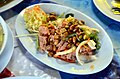 Yam naem
 -
 Phat naem sai khai


See Also[edit]
 Thai cuisine
 |
||||||||||
|---|---|---|---|---|---|---|---|---|---|---|
|
| Sausage | ||||||||||
|---|---|---|---|---|---|---|---|---|---|---|
* Category
|
