Green curry
Green curry is a type of curry that originated from Thailand. It is known as kaeng khiao wan in Thai, which directly translates to "sweet green curry". Despite its name, green curry is not necessarily sweet, but rather refers to the color of the dish, which comes from the green chilies used in its preparation.
History[edit]
Green curry is believed to have been first created during the reign of King Rama 6 or King Rama 7, between the years 1908-1926. It is a relatively recent addition to Thai cuisine compared to other traditional dishes.
Ingredients[edit]
The main ingredients of green curry are green chilies, shallots, garlic, lemongrass, kaffir lime rind, coriander root, cumin seeds, and turmeric. These ingredients are ground together in a mortar and pestle to create a curry paste. This paste is then cooked with coconut milk to form the base of the curry. Proteins such as chicken, beef, pork, or tofu can be added, along with vegetables like eggplant, bamboo shoots, and Thai basil.
Preparation[edit]
The preparation of green curry involves frying the curry paste in oil until fragrant, then adding coconut milk to form a creamy base. The protein and vegetables are then added and simmered until cooked. The dish is typically served with steamed rice or rice noodles.
Variations[edit]
There are several variations of green curry across different regions of Thailand. In the central region, green curry tends to be less spicy and sweeter, often including palm sugar. In the southern region, the curry is typically more spicy and includes additional ingredients like turmeric and bird's eye chili.
See also[edit]
 | This article about Thai cuisine is a stub. You can help WikiMD by expanding the page. |

-
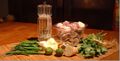 Ingredients for green curry
 -
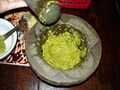 Thai green curry paste
 -
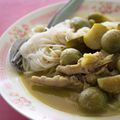 Khanom chin kaeng kiao wan kai
 -
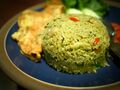 Khao phat kaeng khiao wan
 -
 Green curry


.jpg)

Medical Disclaimer: WikiMD is for informational purposes only and is not a substitute for professional medical advice. Content may be inaccurate or outdated and should not be used for diagnosis or treatment. Always consult your healthcare provider for medical decisions. Verify information with trusted sources such as CDC.gov and NIH.gov. By using this site, you agree that WikiMD is not liable for any outcomes related to its content. See full disclaimer.
Credits:Most images are courtesy of Wikimedia commons, and templates, categories Wikipedia, licensed under CC BY SA or similar.
Translate page: - East Asian
中文,
日本,
한국어,
South Asian
हिन्दी,
தமிழ்,
తెలుగు,
Urdu,
ಕನ್ನಡ,
Southeast Asian
Indonesian,
Vietnamese,
Thai,
မြန်မာဘာသာ,
বাংলা
European
español,
Deutsch,
français,
Greek,
português do Brasil,
polski,
română,
русский,
Nederlands,
norsk,
svenska,
suomi,
Italian
Middle Eastern & African
عربى,
Turkish,
Persian,
Hebrew,
Afrikaans,
isiZulu,
Kiswahili,
Other
Bulgarian,
Hungarian,
Czech,
Swedish,
മലയാളം,
मराठी,
ਪੰਜਾਬੀ,
ગુજરાતી,
Portuguese,
Ukrainian

