Glutinous rice
Glutinic acid is a chemical compound that belongs to the class of organic compounds known as carboxylic acids. It is also known as pentanedioic acid due to its structural similarity to pentane, with two carboxyl groups replacing two of the hydrogen atoms.
Chemical Structure[edit]
Glutinic acid has the chemical formula C5H8O4. It consists of a five-carbon alkane chain, with a carboxyl group (COOH) at each end. This structure is reflected in its systematic name, pentanedioic acid, which indicates a five-carbon chain (pentane) with two carboxyl groups (dioic acid).
Properties[edit]
Glutinic acid is a white, crystalline solid at room temperature. It is soluble in water and can be dissolved in various organic solvents. It has a strong acidic taste and is non-toxic. The acid is a dibasic acid, meaning it can donate two protons per molecule in solution.
Synthesis[edit]
Glutinic acid can be synthesized through the oxidation of cyclopentanol or cyclopentanone with potassium permanganate. It can also be produced from the oxidation of glutaryl chloride with water.
Uses[edit]
Glutinic acid is used in the manufacture of plasticizers, resins, dyes, and pharmaceuticals. It is also used as a laboratory reagent in various chemical reactions.
Safety[edit]
As with all carboxylic acids, glutinic acid should be handled with care. It can cause burns and eye damage, and its dust can cause respiratory irritation.
See Also[edit]

Glutinous_rice[edit]
-
 Chapssal (glutinous rice)
 -
 2014 uncooked Thai glutinous rice
 -
 Glutinous Rice Flour
 -
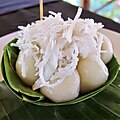 Num Plae Ai
 -
 Pearl Meatballs with Sticky Rice
 -
 Steaming rice
 -
 Lao cuisine ricebasket
 -
 Sticky Rice Myanmar
 -
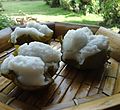 Puto in banana leaf
 -
 Poblacion Baliuag Bulacan
 -
 Puto-bumbong
 -
 Kuchinta at Gerry Shan's Place Baler
.jpg)


Medical Disclaimer: WikiMD is for informational purposes only and is not a substitute for professional medical advice. Content may be inaccurate or outdated and should not be used for diagnosis or treatment. Always consult your healthcare provider for medical decisions. Verify information with trusted sources such as CDC.gov and NIH.gov. By using this site, you agree that WikiMD is not liable for any outcomes related to its content. See full disclaimer.
Credits:Most images are courtesy of Wikimedia commons, and templates, categories Wikipedia, licensed under CC BY SA or similar.
Translate this page: - East Asian
中文,
日本,
한국어,
South Asian
हिन्दी,
தமிழ்,
తెలుగు,
Urdu,
ಕನ್ನಡ,
Southeast Asian
Indonesian,
Vietnamese,
Thai,
မြန်မာဘာသာ,
বাংলা
European
español,
Deutsch,
français,
Greek,
português do Brasil,
polski,
română,
русский,
Nederlands,
norsk,
svenska,
suomi,
Italian
Middle Eastern & African
عربى,
Turkish,
Persian,
Hebrew,
Afrikaans,
isiZulu,
Kiswahili,
Other
Bulgarian,
Hungarian,
Czech,
Swedish,
മലയാളം,
मराठी,
ਪੰਜਾਬੀ,
ગુજરાતી,
Portuguese,
Ukrainian
