Saucisson
Saucisson is a variety of thick, dry cured sausage that originates from France. Typically made of pork, or a mixture of pork and other meats, saucisson is a staple of French charcuterie.
History[edit]
The history of saucisson dates back to ancient times. The Romans, who were fond of cured meats, likely introduced the technique to the Gauls after their conquest of the region that is now modern-day France. The term "saucisson" comes from the Latin salsus, meaning "salted".
Production[edit]
Saucisson is made by stuffing a natural or synthetic casing with coarsely chopped or ground meat, salt, spices, and sometimes wine or brandy. The stuffed casing is then hung to dry for several weeks or even months. The length of the curing process depends on the size of the sausage and the desired level of dryness.
Varieties[edit]
There are many varieties of saucisson, each with its own unique flavor profile. Some of the most popular include:
- Saucisson de Lyon: A sausage from the city of Lyon, known for its delicate flavor and fine texture.
- Saucisson de Montagne: A mountain sausage, typically made with game meats and flavored with juniper berries.
- Saucisson d'Arles: A sausage from the city of Arles, made with a high proportion of fat and flavored with black pepper.
Serving[edit]
Saucisson is typically served sliced thin as part of a charcuterie board, along with other cured meats, cheese, and bread. It can also be used in cooking, where it adds a rich, savory flavor to dishes.
See also[edit]

-
Saucisson
-
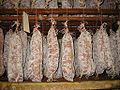 Saucisson


Medical Disclaimer: WikiMD is for informational purposes only and is not a substitute for professional medical advice. Content may be inaccurate or outdated and should not be used for diagnosis or treatment. Always consult your healthcare provider for medical decisions. Verify information with trusted sources such as CDC.gov and NIH.gov. By using this site, you agree that WikiMD is not liable for any outcomes related to its content. See full disclaimer.
Credits:Most images are courtesy of Wikimedia commons, and templates, categories Wikipedia, licensed under CC BY SA or similar.
Translate page: - East Asian
中文,
日本,
한국어,
South Asian
हिन्दी,
தமிழ்,
తెలుగు,
Urdu,
ಕನ್ನಡ,
Southeast Asian
Indonesian,
Vietnamese,
Thai,
မြန်မာဘာသာ,
বাংলা
European
español,
Deutsch,
français,
Greek,
português do Brasil,
polski,
română,
русский,
Nederlands,
norsk,
svenska,
suomi,
Italian
Middle Eastern & African
عربى,
Turkish,
Persian,
Hebrew,
Afrikaans,
isiZulu,
Kiswahili,
Other
Bulgarian,
Hungarian,
Czech,
Swedish,
മലയാളം,
मराठी,
ਪੰਜਾਬੀ,
ગુજરાતી,
Portuguese,
Ukrainian


