Physical education
Physical education (often abbreviated as PE) pertains to the instruction focused on the development, care, and maintenance of the human body. This educational discipline emphasizes both athletic endeavors and holistic health principles, including hygiene practices. Through a structured curriculum, physical education seeks to promote lifelong wellness habits, physical fitness, motor skill development, and cognitive understanding about the importance of maintaining an active lifestyle.
Historical Background[edit]
Physical education has ancient roots, with civilizations like the Greeks placing significant emphasis on physical training, both for the purpose of military preparedness and for cultural events like the Olympics. Over the centuries, the significance of physical training in educational systems has varied, with a resurgence of interest in the modern era due to increasing concerns about sedentary lifestyles and associated health risks.
Core Components[edit]
- Athletics: Physical education programs often include a diverse array of sports and physical activities ranging from team sports like basketball and soccer to individual activities such as running and swimming.
- Fitness Training: This component focuses on improving cardiovascular endurance, muscular strength, flexibility, and overall physical stamina.
- Motor Skills Development: Here, emphasis is placed on refining skills like balance, agility, and coordination.
- Hygiene: Beyond just physical activity, PE programs also impart knowledge on personal hygiene, nutrition, and habits that contribute to overall well-being.
Benefits[edit]
Physical education offers numerous benefits including:
- Improved physical health and lowered risk of chronic diseases.
- Enhanced cognitive function and academic performance.
- Development of teamwork and leadership skills through group sports.
- Stress reduction and improved mental well-being.
Contemporary Challenges[edit]
With the advent of technology and an increasingly sedentary lifestyle, the role of physical education is more critical than ever. However, PE programs face challenges such as:
- Reduced funding and deprioritization in school curriculums.
- Overemphasis on standardized testing, often at the expense of physical activity time.
- Lack of facilities and equipment in certain schools.
- Variability in the quality and training of physical education instructors.
Future of Physical Education[edit]
In response to contemporary challenges, there is a push to reimagine and modernize physical education. This includes:
- Incorporation of technology: Using wearables and apps to track and motivate physical activity.
- Focus on lifelong fitness habits rather than competitive sports alone.
- Emphasis on mental health and holistic wellness, integrating practices like yoga and mindfulness.
See Also[edit]
| Sport | ||||||||||
|---|---|---|---|---|---|---|---|---|---|---|
|
| This article is a stub. You can help WikiMD by registering to expand it. |
-
 Physical education equipment at Calhan High School
 -
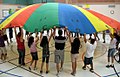 Physical education class
 -
 School cross-country event
 -
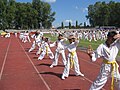 Karate kids in training
 -
 Okemos High School Girls' Water Polo State Championship Team 2011
 -
 Gymnastics on bars by Amy Winczura


_Amy_Winczura_(5694030475).jpg)
Medical Disclaimer: WikiMD is for informational purposes only and is not a substitute for professional medical advice. Content may be inaccurate or outdated and should not be used for diagnosis or treatment. Always consult your healthcare provider for medical decisions. Verify information with trusted sources such as CDC.gov and NIH.gov. By using this site, you agree that WikiMD is not liable for any outcomes related to its content. See full disclaimer.
Credits:Most images are courtesy of Wikimedia commons, and templates, categories Wikipedia, licensed under CC BY SA or similar.
Translate this page: - East Asian
中文,
日本,
한국어,
South Asian
हिन्दी,
தமிழ்,
తెలుగు,
Urdu,
ಕನ್ನಡ,
Southeast Asian
Indonesian,
Vietnamese,
Thai,
မြန်မာဘာသာ,
বাংলা
European
español,
Deutsch,
français,
Greek,
português do Brasil,
polski,
română,
русский,
Nederlands,
norsk,
svenska,
suomi,
Italian
Middle Eastern & African
عربى,
Turkish,
Persian,
Hebrew,
Afrikaans,
isiZulu,
Kiswahili,
Other
Bulgarian,
Hungarian,
Czech,
Swedish,
മലയാളം,
मराठी,
ਪੰਜਾਬੀ,
ગુજરાતી,
Portuguese,
Ukrainian
