Jasmine rice
Jasmine rice (also known as Thai fragrant rice) is a long-grain variety of fragrant rice (also known as aromatic rice). Its fragrance, reminiscent of pandan (Pandanus amaryllifolius) and popcorn, results from the rice plant's natural production of aroma compounds, of which 2-acetyl-1-pyrroline is the most salient. In typical packaging and storage, these aromatic compounds dissipate within a few months. This rapid loss of aromatic intensity leads many Southeast Asians and connoisseurs to prefer each year's freshly harvested "new crop" of jasmine rice.
Origin and production[edit]
Jasmine rice is originally from Thailand. The name "jasmine" refers to the color of the rice, which is as white as the jasmine flower. It is cultivated primarily in Thailand (Thai hom mali or Thai fragrant rice), Cambodia (angkor kra'oup or Cambodian jasmine rice), Laos, and southern Vietnam. It is also cultivated in the U.S. states of Texas and Arkansas.
Cooking[edit]
Jasmine rice is traditionally cooked by steaming, or by boiling in an excess of water (the pasta method). Steaming preserves the stickiness of the rice, which is an important element in East Asian cuisine, while the pasta method reduces stickiness.
Nutritional value[edit]
Jasmine rice is high in carbohydrates and calories, as is typical for all rice varieties. However, it is low in fat and protein. It also lacks many vitamins and minerals, so it should be eaten as part of a balanced diet.
See also[edit]
| Rice Varieties | ||||||||
|---|---|---|---|---|---|---|---|---|
This rice varieties related article is a stub.
|
 Thai cuisine
 |
||||||||||
|---|---|---|---|---|---|---|---|---|---|---|
|
 Vietnamese cuisine
 |
||||||||||
|---|---|---|---|---|---|---|---|---|---|---|
|

-
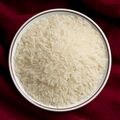 Uncooked Thai jasmine rice
 -
Gai Pad Krapow
-
Khao Mun Kai
-
Green Curry


Medical Disclaimer: WikiMD is for informational purposes only and is not a substitute for professional medical advice. Content may be inaccurate or outdated and should not be used for diagnosis or treatment. Always consult your healthcare provider for medical decisions. Verify information with trusted sources such as CDC.gov and NIH.gov. By using this site, you agree that WikiMD is not liable for any outcomes related to its content. See full disclaimer.
Credits:Most images are courtesy of Wikimedia commons, and templates, categories Wikipedia, licensed under CC BY SA or similar.
Translate page: - East Asian
中文,
日本,
한국어,
South Asian
हिन्दी,
தமிழ்,
తెలుగు,
Urdu,
ಕನ್ನಡ,
Southeast Asian
Indonesian,
Vietnamese,
Thai,
မြန်မာဘာသာ,
বাংলা
European
español,
Deutsch,
français,
Greek,
português do Brasil,
polski,
română,
русский,
Nederlands,
norsk,
svenska,
suomi,
Italian
Middle Eastern & African
عربى,
Turkish,
Persian,
Hebrew,
Afrikaans,
isiZulu,
Kiswahili,
Other
Bulgarian,
Hungarian,
Czech,
Swedish,
മലയാളം,
मराठी,
ਪੰਜਾਬੀ,
ગુજરાતી,
Portuguese,
Ukrainian


.jpg)

