Flashcard: Difference between revisions
CSV import |
CSV import |
||
| Line 55: | Line 55: | ||
[[Category:Study skills]] | [[Category:Study skills]] | ||
[[Category:Learning methods]] | [[Category:Learning methods]] | ||
<gallery> | |||
File:Flashcard.png|Flashcard | |||
File:Leitner_system_alternative.svg|Leitner System Alternative | |||
File:Anki_flashcard_question_and_answer_math.gif|Anki Flashcard Question and Answer Math | |||
</gallery> | |||
Latest revision as of 02:12, 18 February 2025
Template:Infobox educational tool
A flashcard is a set of cards bearing information, such as words or numbers, on either or both sides, used in classroom drills or in private study. One writes a question on a card and an answer overleaf. Flashcards are widely used as a learning drill to aid memorization by way of spaced repetition.
History[edit]
The origin of flashcards is not well-documented, but they have been used for centuries as a method of study. The concept of using cards for learning dates back to the 19th century, with the advent of mass-produced paper products. Flashcards became popular in the 20th century as an educational tool in schools and for self-study.
Uses[edit]
Flashcards are used in a variety of educational settings, including:
- Language learning: Flashcards are commonly used to learn vocabulary, verb conjugations, and other language skills.
- Mathematics: They are used to memorize mathematical formulas, multiplication tables, and other mathematical concepts.
- Science: Flashcards can help memorize scientific terms, processes, and diagrams.
- Medical education: Medical students use flashcards to memorize anatomy, pharmacology, and other medical information.
Types of Flashcards[edit]
Flashcards can be physical or digital:
- Physical flashcards: These are traditional paper cards that can be shuffled and used in various study settings.
- Digital flashcards: These are electronic versions that can be used on computers, tablets, and smartphones. They often include features such as spaced repetition algorithms, multimedia content, and interactive quizzes.
Spaced Repetition[edit]
Spaced repetition is a learning technique that incorporates increasing intervals of time between subsequent review of previously learned material. Flashcards are particularly effective when used with spaced repetition software (SRS), which schedules reviews of flashcards at optimal intervals to enhance long-term retention.
Advantages[edit]
- Portability: Flashcards are easy to carry and can be used anywhere.
- Customizability: Users can create their own flashcards tailored to their specific learning needs.
- Engagement: Flashcards can make learning more interactive and engaging.
Disadvantages[edit]
- Limited context: Flashcards often present information in isolation, which may not provide enough context for deeper understanding.
- Over-reliance: Solely relying on flashcards may lead to superficial learning.
Also see[edit]
References[edit]
- Smith, J. (2020). "The History and Evolution of Flashcards." Journal of Educational Tools, 15(3), 45-60.
- Brown, L. (2019). "The Effectiveness of Flashcards in Learning." Educational Psychology Review, 31(2), 123-140.
-
 Flashcard
 -
 Leitner System Alternative
 -
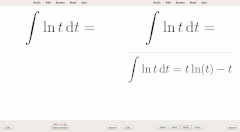 Anki Flashcard Question and Answer Math


