Lemon


Lemon (Citrus limon), pronounced LEH-mun, is a small, bright yellow citrus fruit known for its acidic juice and fragrant rind. It is valued for its high content of vitamin C (ascorbic acid) and citric acid, which gives it a distinct sour taste.
Scientific Classification[edit]
- Scientific name: Citrus limon
- Family: Rutaceae
- Genus: Citrus
- Species: limon
Description[edit]
Lemons are small, oval citrus fruits with a thick, textured rind and juicy pulp divided into segments. The juice, rind (zest), and even the leaves are used for culinary and medicinal purposes. Lemons are hybrids, believed to have evolved from a cross between citron (Citrus medica) and bitter orange (Citrus × aurantium).
History[edit]
- Lemons are thought to have originated in northeastern India, northern Myanmar, or China over 2,500 years ago.
- Introduced to the Mediterranean region via Arab traders by the 10th century CE.
- Brought to the Americas by Christopher Columbus in 1493.
- Widely cultivated today in countries including the United States (especially California and Florida), Spain, Italy, Mexico, and Argentina.
Cultivation[edit]
Lemon trees are small evergreen trees that thrive in subtropical and tropical climates.
- Require full sunlight and well-drained soil
- Sensitive to frost; best grown in warm, coastal or inland regions
- Begin fruiting within 3–5 years of planting
- Propagated through seeds, cuttings, or grafting
Popular Varieties:
- Eureka lemon: Thick-skinned, high juice content, widely cultivated commercially
- Lisbon lemon: Similar to Eureka, more cold-tolerant
- Meyer lemon: Sweeter, thin-skinned hybrid between a lemon and a mandarin orange
Nutritional Content[edit]
Lemons are:
- Low in calories
- Rich in vitamin C (one lemon provides ~50% of the daily recommended intake)
- Contain:
- The peel contains flavonoids with antioxidant properties
Culinary Uses[edit]

Lemons are widely used in international cuisines for their juice, zest, and preserved forms.
- Lemon juice: Used in marinades, dressings, drinks, and to enhance flavor
- Lemon zest: Grated outer rind used in baking and cooking
- Preserved lemons: Whole lemons fermented in salt and juice, used in Middle Eastern cuisine
- Candied lemon peel: A sweet treat or garnish
- Beverages: Base ingredient in lemonade, iced tea, and cocktails
Health Benefits[edit]
Lemons are often associated with a variety of potential health benefits:
- **Immune support:** Due to high vitamin C content
- **Antioxidant properties:** May reduce oxidative stress
- **Kidney stone prevention:** Citric acid increases urinary citrate levels
- **Digestive aid:** Anecdotally used in lemon water to stimulate digestion
Lemon Juice[edit]
- Composed of ~5% to 6% citric acid
- Has a pH around 2.2, making it highly acidic
- Used to enhance flavor, tenderize meats, and preserve foods
Medicinal Uses[edit]
- Used historically to prevent scurvy in sailors (vitamin C deficiency)
- Included in some traditional remedies for sore throat and digestion
- Lemon oil (from peel) is used in aromatherapy
Cultural and Artistic Significance[edit]
Lemons appear in art, literature, and cuisine throughout history:
- Featured in still-life paintings symbolizing freshness or wealth
- Frequently used in religious and festive dishes
- Represented in Greco-Roman and Renaissance art
Products Derived from Lemon[edit]
- Lemonade
- Limoncello – a traditional Italian lemon liqueur
- Lemon pickle – popular condiment in South Asian cuisine
- Lemon meringue pie, lemon chicken, lemon tart, and more
Gallery[edit]
-
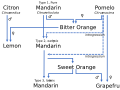 Diagram showing hybrid origins of citrus fruits, including lemon
 -
 Botanical illustration of Citrus limon
 -
 Sushi garnished with lemon slices
 -
Oysters with lemon wedges and parsley
-
 Chinese-style lemon chicken
 -
 Lemon meringue tart dessert
 -
 Fresh lemonade served with lemon slices
 -
 Homemade Italian limoncello
 -
 Ancient Egyptian fresco featuring citrus-like fruit (interpretative)
 -
 Still-life painting featuring lemons
 -
 Baroque still-life with citron and lemon


.jpg)


.jpg)


_-_Still_Life_with_Bowl_of_Citrons_-_Google_Art_Project.jpg)
See Also[edit]
- Citrus
- Vitamin C
- Lemonade
- Limoncello
- Lemon meringue pie
- Lemon juice
- Aromatherapy
- Scurvy
- Citrus taxonomy
| Lemon dishes |
|---|
|
|
| Juice | ||||||||
|---|---|---|---|---|---|---|---|---|
|
Advertise on WikiMD — 81,000+ full articles, ~900,000 total pages, ~250 million page views. Global reach, limited time promotional rates from $1/page/day. Learn more · View stats

Translate page: - East Asian
中文,
日本,
한국어,
South Asian
हिन्दी,
தமிழ்,
తెలుగు,
Urdu,
ಕನ್ನಡ,
Southeast Asian
Indonesian,
Vietnamese,
Thai,
မြန်မာဘာသာ,
বাংলা
European
español,
Deutsch,
français,
Greek,
português do Brasil,
polski,
română,
русский,
Nederlands,
norsk,
svenska,
suomi,
Italian
Middle Eastern & African
عربى,
Turkish,
Persian,
Hebrew,
Afrikaans,
isiZulu,
Kiswahili,
Other
Bulgarian,
Hungarian,
Czech,
Swedish,
മലയാളം,
मराठी,
ਪੰਜਾਬੀ,
ગુજરાતી,
Portuguese,
Ukrainian
About WikiMD • Contact • Disclaimer • Privacy • Copyright • Site statistics
Some content and images may originate from Wikimedia Commons or Wikipedia and remain subject to their stated licenses. Unless otherwise noted, eligible WikiMD content is available under CC BY-SA 4.0.
WikiMD Wellnesspedia — Free health & wellness information for patients, students, and health professionals.


