Cardiopulmonary resuscitation
Cardiopulmonary resuscitation (CPR) is an emergency procedure that combines the use of chest compressions, often with artificial ventilation, in an effort to manually preserve intact brain function until further measures are taken to restore spontaneous blood circulation and breathing in a person who is in cardiac arrest. It is recommended for those who are unresponsive with no breathing or abnormal breathing, for example, agonal respirations.
Indications[edit]
CPR is indicated for any person unresponsive with no breathing or only gasping, as it can increase the chances of survival following cardiac arrest. The procedure is crucial in the critical moments before emergency medical services (EMS) arrive, as it can double or even triple a cardiac arrest victim's chance of survival.
Technique[edit]
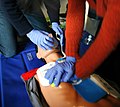
CPR involves two main components: chest compressions and rescue breaths. The current guidelines recommend performing chest compressions to the depth of at least 2 inches (5 cm) for adults, at a rate of 100 to 120 compressions per minute. The rescuer should allow the chest to fully recoil between compressions. If trained and able, the rescuer should also give rescue breaths after every 30 compressions.
Chest Compressions[edit]
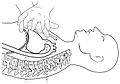
Chest compressions are delivered to the center of the chest, aiming to manually pump the heart and circulate blood to vital organs. The effectiveness of compressions can be affected by the rescuer's fatigue, hence it is recommended to switch rescuers every 2 minutes.
Rescue Breaths[edit]
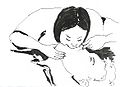
Rescue breaths are given to provide oxygen to the victim's lungs. It is performed by tilting the victim's head back, lifting the chin, and then giving two breaths while watching for chest rise, which indicates that the lungs are inflating.
Automated External Defibrillators (AEDs)[edit]
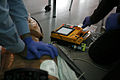
In many public places, Automated External Defibrillators (AEDs) are available and can be used in conjunction with CPR. An AED is a portable device that checks the heart rhythm and can send an electric shock to the heart to try to restore a normal rhythm.
Training and Certification[edit]
Training in CPR is offered by many hospitals, community centers, and organizations like the American Heart Association and the Red Cross. Certification courses teach individuals how to recognize the signs of a cardiac emergency, perform CPR, and use an AED.
History[edit]
CPR developed from techniques like mouth-to-mouth resuscitation and has evolved significantly since the mid-20th century. Advances in science and feedback from real-world applications have refined the technique to its current form.
Legal and Ethical Considerations[edit]
In many regions, Good Samaritan laws protect individuals who voluntarily give CPR in an emergency. However, consent is implied if the victim is unconscious and in need of immediate, life-saving intervention.
See also[edit]
| First aid | ||||||||||
|---|---|---|---|---|---|---|---|---|---|---|
|
| Emergency medicine | ||||||||||
|---|---|---|---|---|---|---|---|---|---|---|
|
| Tests and procedures involving the respiratory system | ||||||
|---|---|---|---|---|---|---|
|
| Tests and procedures involving the heart | ||||||||||
|---|---|---|---|---|---|---|---|---|---|---|
|
-
 Cardiopulmonary resuscitation
 -
 Cardiopulmonary resuscitation
 -
 Cardiopulmonary resuscitation
 -
 Cardiopulmonary resuscitation
 -
 Cardiopulmonary resuscitation
 -
 Cardiopulmonary resuscitation
 -
 Cardiopulmonary resuscitation
 -
 Cardiopulmonary resuscitation
 -
 Cardiopulmonary resuscitation
 -
 Cardiopulmonary resuscitation
 -
 Cardiopulmonary resuscitation


.jpg)
Ad. Transform your life with W8MD's
GLP-1 weight loss injections special from $29.99


W8MD Medical Weight Loss, Sleep and Medspa offers physician-supervised medical weight loss programs: NYC medical weight loss Philadelphia medical weight loss
Affordable GLP-1 Weight Loss ShotsAffordable GLP-1 Weight Loss Shots
Budget GLP-1 injections NYC (insurance & self-pay options) Popular treatments:
- Semaglutide starting from $29.99/week
- Tirzepatide starting from $45.00/week
✔ Most insurances accepted for visits ✔ Prior authorization support when eligible
Start your physician weight loss NYC journey today:
📍 NYC: Brooklyn weight loss center 📍 Philadelphia: Philadelphia weight loss center
📞 Call: 718-946-5500 (NYC) | 215-676-2334 (Philadelphia)
Tags: Affordable GLP1 weight loss NYC, Wegovy NYC, Zepbound NYC, Philadelphia medical weight loss


|
WikiMD Medical Encyclopedia |
Medical Disclaimer: WikiMD is not a substitute for professional medical advice. The information on WikiMD is provided as an information resource only, may be incorrect, outdated or misleading, and is not to be used or relied on for any diagnostic or treatment purposes. Please consult your health care provider before making any healthcare decisions or for guidance about a specific medical condition. WikiMD expressly disclaims responsibility, and shall have no liability, for any damages, loss, injury, or liability whatsoever suffered as a result of your reliance on the information contained in this site. By visiting this site you agree to the foregoing terms and conditions, which may from time to time be changed or supplemented by WikiMD. If you do not agree to the foregoing terms and conditions, you should not enter or use this site. See full disclaimer.
Credits:Most images are courtesy of Wikimedia commons, and templates, categories Wikipedia, licensed under CC BY SA or similar.
Translate this page: - East Asian
中文,
日本,
한국어,
South Asian
हिन्दी,
தமிழ்,
తెలుగు,
Urdu,
ಕನ್ನಡ,
Southeast Asian
Indonesian,
Vietnamese,
Thai,
မြန်မာဘာသာ,
বাংলা
European
español,
Deutsch,
français,
Greek,
português do Brasil,
polski,
română,
русский,
Nederlands,
norsk,
svenska,
suomi,
Italian
Middle Eastern & African
عربى,
Turkish,
Persian,
Hebrew,
Afrikaans,
isiZulu,
Kiswahili,
Other
Bulgarian,
Hungarian,
Czech,
Swedish,
മലയാളം,
मराठी,
ਪੰਜਾਬੀ,
ગુજરાતી,
Portuguese,
Ukrainian
