Pericardiocentesis
Pericardiocentesis
Pericardiocentesis is a medical procedure used to remove fluid from the pericardial cavity, the space around the heart enclosed by the pericardium. This procedure is typically performed to relieve pressure on the heart due to pericardial effusion or cardiac tamponade.
Indications[edit]
Pericardiocentesis is indicated in several clinical scenarios, including:
- Cardiac tamponade
- Large or symptomatic pericardial effusion
- Diagnostic evaluation of pericardial fluid
- Therapeutic relief of symptoms associated with fluid accumulation
Contraindications[edit]
While pericardiocentesis is generally safe, there are contraindications, such as:
- Uncorrected coagulopathy
- Small, asymptomatic effusions
- Loculated effusions that are not accessible
Procedure[edit]
The procedure is typically performed under ultrasound or echocardiography guidance to increase safety and accuracy. The steps include:
1. Preparation: The patient is positioned supine with the head elevated. The skin is cleaned and draped. 2. Local Anesthesia: Local anesthetic is administered to the skin and deeper tissues. 3. Needle Insertion: A needle is inserted into the pericardial space, usually via the subxiphoid approach. 4. Fluid Aspiration: Fluid is aspirated and collected for analysis. 5. Catheter Placement: A catheter may be placed for continuous drainage if necessary.
Complications[edit]
Potential complications of pericardiocentesis include:
Recovery and Follow-up[edit]
After the procedure, patients are monitored for signs of complications. Follow-up may include:
- Repeat echocardiogram to assess fluid reaccumulation
- Monitoring of vital signs and cardiac function
See Also[edit]
External Links[edit]
- [American Heart Association](https://www.heart.org)
- [Mayo Clinic](https://www.mayoclinic.org)
| Medical procedures | ||||||||||
|---|---|---|---|---|---|---|---|---|---|---|
|
Pericardiocentesis[edit]
-
 Pericardiocentesis
 -
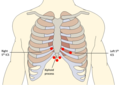 Pericardiocentesis locations


Medical Disclaimer: WikiMD is for informational purposes only and is not a substitute for professional medical advice. Content may be inaccurate or outdated and should not be used for diagnosis or treatment. Always consult your healthcare provider for medical decisions. Verify information with trusted sources such as CDC.gov and NIH.gov. By using this site, you agree that WikiMD is not liable for any outcomes related to its content. See full disclaimer.
Credits:Most images are courtesy of Wikimedia commons, and templates, categories Wikipedia, licensed under CC BY SA or similar.
Translate page: - East Asian
中文,
日本,
한국어,
South Asian
हिन्दी,
தமிழ்,
తెలుగు,
Urdu,
ಕನ್ನಡ,
Southeast Asian
Indonesian,
Vietnamese,
Thai,
မြန်မာဘာသာ,
বাংলা
European
español,
Deutsch,
français,
Greek,
português do Brasil,
polski,
română,
русский,
Nederlands,
norsk,
svenska,
suomi,
Italian
Middle Eastern & African
عربى,
Turkish,
Persian,
Hebrew,
Afrikaans,
isiZulu,
Kiswahili,
Other
Bulgarian,
Hungarian,
Czech,
Swedish,
മലയാളം,
मराठी,
ਪੰਜਾਬੀ,
ગુજરાતી,
Portuguese,
Ukrainian

