Isavuconazonium
Information about Isavuconazonium[edit]
Isavuconazonium is a triazole antifungal agent used primarily in the treatment of invasive aspergillosis and mucormycosis infections.
Liver safety of Isavuconazonium[edit]
Isavuconazonium is associated with a low rate of transient and asymptomatic serum aminotransferase elevations during therapy, but has not been linked to instances of clinically apparent acute drug induced liver injury.
Mechanism of action of Isavuconazonium[edit]
Isavuconazonium (eye" sa vue koe" na zoe' nee um) is a synthetic triazole and prodrug of isavuconazole, the active moiety. Similar to other triazoles, such as voriconazole and itraconazole, isavuconazole is believed to act through inhibition of the fungal 14a-ergosterol demethylase that is responsible for converting lanosterol to ergosterol, which blocks fungal cell membrane synthesis. Isavuconazonium has a broad spectrum of activity particularly against many aspergillus, candida and mucormycosis species.
FDA approval information for Isavuconazonium[edit]
Isavuconazonium was approved for use in the United States in 2016. Current indications include treatment of invasive aspergillosis and mucormycosis infections in adults. It is under active evaluation as therapy of invasive candida infections. Isavuconazonium is available as capsules of 186 mg and as powder for reconstitution in single use vials of 372 mg under the brand name Cresemba.
Dosage and administration for Isavuconazonium[edit]
The recommended regimen is 372 mg every 8 hours for 2 days, and then 372 mg daily until cure or clearance of the fungal infection. Isavuconazonium is typically given intravenously for the first few days and then in oral forms, the recommended total daily dose being the same.
Side effects of Isavuconazonium[edit]
Common side effects include nausea, diarrhea, headache, constipation, cough, dyspnea, peripheral edema and back pain. Intravenous administration can also be accompanied by hypotension, chills, dizziness and hypesthesia.
-
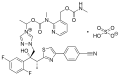 Isavuconazonium sulfate structure
 -
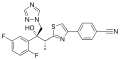 Isavuconazole chemical structure
 -
 Isavuconazole ball-and-stick model


Medical Disclaimer: WikiMD is for informational purposes only and is not a substitute for professional medical advice. Content may be inaccurate or outdated and should not be used for diagnosis or treatment. Always consult your healthcare provider for medical decisions. Verify information with trusted sources such as CDC.gov and NIH.gov. By using this site, you agree that WikiMD is not liable for any outcomes related to its content. See full disclaimer.
Credits:Most images are courtesy of Wikimedia commons, and templates, categories Wikipedia, licensed under CC BY SA or similar.
Translate page: - East Asian
中文,
日本,
한국어,
South Asian
हिन्दी,
தமிழ்,
తెలుగు,
Urdu,
ಕನ್ನಡ,
Southeast Asian
Indonesian,
Vietnamese,
Thai,
မြန်မာဘာသာ,
বাংলা
European
español,
Deutsch,
français,
Greek,
português do Brasil,
polski,
română,
русский,
Nederlands,
norsk,
svenska,
suomi,
Italian
Middle Eastern & African
عربى,
Turkish,
Persian,
Hebrew,
Afrikaans,
isiZulu,
Kiswahili,
Other
Bulgarian,
Hungarian,
Czech,
Swedish,
മലയാളം,
मराठी,
ਪੰਜਾਬੀ,
ગુજરાતી,
Portuguese,
Ukrainian

