Hexaconazole
Hexaconazole is a fungicide used in agriculture to control a wide range of fungi that cause plant diseases. It belongs to the class of triazole fungicides, which are known for their broad-spectrum activity against both ascomycetes and basidiomycetes.
Chemistry[edit]
Hexaconazole is a synthetic compound with the chemical formula C14H17Cl2N3O. It is a member of the triazole class of compounds, which are characterized by the presence of a five-membered ring containing two carbon atoms and three nitrogen atoms. Hexaconazole is a chiral molecule, meaning it has a non-superimposable mirror image.
Mode of Action[edit]
Hexaconazole works by inhibiting the biosynthesis of ergosterol, a critical component of fungal cell membranes. This disruption in ergosterol production leads to changes in membrane permeability and function, ultimately resulting in fungal cell death.
Use in Agriculture[edit]
Hexaconazole is used in agriculture to control a wide range of fungal diseases in crops such as rice, wheat, maize, soybeans, and fruit trees. It is typically applied as a foliar spray, seed treatment, or soil drench.
Safety and Environmental Impact[edit]
Like all pesticides, hexaconazole must be used responsibly to minimize potential harm to non-target organisms and the environment. It is moderately toxic to mammals and birds, but highly toxic to fish and aquatic invertebrates. It is also persistent in the environment and can accumulate in soil and water bodies.
Regulation[edit]
In many countries, the use of hexaconazole is regulated by government agencies such as the EPA in the United States and the ECHA in the European Union. These agencies set maximum residue levels (MRLs) for hexaconazole in food and monitor its use and impact on the environment.
See Also[edit]

 | This agriculture article is a stub. You can help WikiMD by expanding the page. |
Hexaconazole[edit]
-
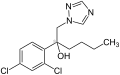 Hexaconazole Structural Formula V.1


Medical Disclaimer: WikiMD is for informational purposes only and is not a substitute for professional medical advice. Content may be inaccurate or outdated and should not be used for diagnosis or treatment. Always consult your healthcare provider for medical decisions. Verify information with trusted sources such as CDC.gov and NIH.gov. By using this site, you agree that WikiMD is not liable for any outcomes related to its content. See full disclaimer.
Credits:Most images are courtesy of Wikimedia commons, and templates, categories Wikipedia, licensed under CC BY SA or similar.
Translate page: - East Asian
中文,
日本,
한국어,
South Asian
हिन्दी,
தமிழ்,
తెలుగు,
Urdu,
ಕನ್ನಡ,
Southeast Asian
Indonesian,
Vietnamese,
Thai,
မြန်မာဘာသာ,
বাংলা
European
español,
Deutsch,
français,
Greek,
português do Brasil,
polski,
română,
русский,
Nederlands,
norsk,
svenska,
suomi,
Italian
Middle Eastern & African
عربى,
Turkish,
Persian,
Hebrew,
Afrikaans,
isiZulu,
Kiswahili,
Other
Bulgarian,
Hungarian,
Czech,
Swedish,
മലയാളം,
मराठी,
ਪੰਜਾਬੀ,
ગુજરાતી,
Portuguese,
Ukrainian

