Salami


Salami is a type of cured sausage consisting of fermented and air-dried meat, typically pork. Historically, salami has been popular among Southern European peasants because it can be stored at room temperature for up to 40 days once cut, supplementing a potentially meager or inconsistent supply of fresh meat.
Ingredients[edit]
Salami is made from a mixture of meat, fat, wine, salt, and various herbs and spices. The ingredients are usually combined with lactic acid bacteria to aid in the fermentation process. Common spices include garlic, pepper, and fennel.
Production Process[edit]
The production of salami involves several steps:
- Preparation of Meat and Fat: The meat and fat are ground to the desired consistency.
- Mixing: The ground meat and fat are mixed with salt, spices, and other ingredients.
- Stuffing: The mixture is stuffed into casings, which can be natural or synthetic.
- Fermentation: The stuffed salami is left to ferment, allowing beneficial bacteria to develop.
- Drying: The salami is hung to dry in a controlled environment, which can take several weeks to months.
Types of Salami[edit]
There are many varieties of salami, each with unique characteristics:
- Genoa Salami: Made with pork and seasoned with garlic, salt, and pepper.
- Soppressata: A coarsely ground salami with a robust flavor, often made with red pepper flakes.
- Pepperoni: A spicy salami commonly used as a pizza topping in the United States.
Nutritional Information[edit]
Salami is a rich source of protein and fat, but it is also high in sodium and calories. It should be consumed in moderation as part of a balanced diet.
Health Considerations[edit]
While salami can be a flavorful addition to meals, it is important to be aware of its high sodium content, which can contribute to hypertension if consumed in excess. Additionally, some salami varieties may contain nitrates and nitrites, which are used as preservatives but have been linked to health concerns.
Gallery[edit]
-
 Telaio porta salami - Musei del cibo
 -
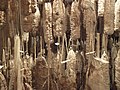 Salumi Valli Unite
 -
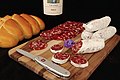 Pane e Salame
 -
 Salame ticinese
 -
 Finocchiona from Tuscany
 -
 Salame friulano


See Also[edit]
References[edit]
- "The Art of Making Fermented Sausages" by Stanley Marianski
- "Charcuterie: The Craft of Salting, Smoking, and Curing" by Michael Ruhlman
External Links[edit]
| Meat | ||||||||||
|---|---|---|---|---|---|---|---|---|---|---|
|
| Sausage | ||||||||||
|---|---|---|---|---|---|---|---|---|---|---|
* Category
|
Ad. Transform your health with W8MD Weight Loss, Sleep & MedSpa

Tired of being overweight?
Special offer:
Budget GLP-1 weight loss medications
- Semaglutide starting from $29.99/week and up with insurance for visit of $59.99 and up per week self pay.
- Tirzepatide starting from $45.00/week and up (dose dependent) or $69.99/week and up self pay
✔ Same-week appointments, evenings & weekends
Learn more:
- GLP-1 weight loss clinic NYC
- W8MD's NYC medical weight loss
- W8MD Philadelphia GLP-1 shots
- Philadelphia GLP-1 injections
- Affordable GLP-1 shots NYC
|
WikiMD Medical Encyclopedia |
Medical Disclaimer: WikiMD is for informational purposes only and is not a substitute for professional medical advice. Content may be inaccurate or outdated and should not be used for diagnosis or treatment. Always consult your healthcare provider for medical decisions. Verify information with trusted sources such as CDC.gov and NIH.gov. By using this site, you agree that WikiMD is not liable for any outcomes related to its content. See full disclaimer.
Credits:Most images are courtesy of Wikimedia commons, and templates, categories Wikipedia, licensed under CC BY SA or similar.
Translate this page: - East Asian
中文,
日本,
한국어,
South Asian
हिन्दी,
தமிழ்,
తెలుగు,
Urdu,
ಕನ್ನಡ,
Southeast Asian
Indonesian,
Vietnamese,
Thai,
မြန်မာဘာသာ,
বাংলা
European
español,
Deutsch,
français,
Greek,
português do Brasil,
polski,
română,
русский,
Nederlands,
norsk,
svenska,
suomi,
Italian
Middle Eastern & African
عربى,
Turkish,
Persian,
Hebrew,
Afrikaans,
isiZulu,
Kiswahili,
Other
Bulgarian,
Hungarian,
Czech,
Swedish,
മലയാളം,
मराठी,
ਪੰਜਾਬੀ,
ગુજરાતી,
Portuguese,
Ukrainian
