Herring as food
| Herring | |

| |
| Taxon | Clupeidae |
| Subfamilies | |
| Genus | Clupea |
| Species | * Clupea harengus
|
| [[File:|250px|]] | |
Herring are small, schooling forage fish that belong predominantly to the family Clupeidae. Although they play a crucial role in the marine ecosystem as a food source for larger fish and marine mammals, herring are also an essential food for humans. They are commonly found in large schools near fishing banks and along coastlines.
Species and Distribution[edit]
The most abundant and commercially significant herring species belong to the genus Clupea, which can be found in the shallow, temperate waters of the North Pacific and North Atlantic Oceans. These fish also inhabit the Baltic Sea, as well as the waters off the west coast of South America. There are three recognized species within the genus Clupea:
Atlantic herring (Clupea harengus) Pacific herring (Clupea pallasii) Araucanian herring (Clupea bentincki) The Atlantic herring is the primary species, accounting for over half of the global commercial capture of herring.
Ecology and Life Cycle[edit]
Herring are a crucial part of the marine food chain, serving as prey for a variety of larger fish, seabirds, and marine mammals. They are filter feeders, consuming plankton, copepods, and other small organisms. Herring have a relatively short life cycle, with most species maturing within 3 to 5 years. Spawning typically occurs in shallow waters, and eggs are deposited on vegetation or other substrates.
Commercial Significance[edit]
Herring are a vital source of food for humans and have been commercially fished for centuries. They are caught using methods such as purse seining, trawling, and gillnetting. Herring can be consumed fresh, smoked, pickled, or canned, and are often processed into fish meal, fish oil, or other products. The global demand for herring remains strong, and the fishery is carefully managed to ensure sustainable populations.
Conservation and Management[edit]
Due to their economic importance, herring populations are closely monitored by various national and international fisheries organizations. Management practices include fishing quotas, seasonal closures, and gear restrictions to help maintain sustainable populations and reduce the impact on the marine ecosystem.

-
 Herring as food
 -
 Herring as food
 -
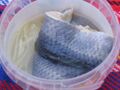 Herring as food
 -
 Herring as food
 -
 Herring as food
 -
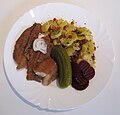 Herring as food
 -
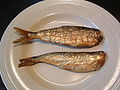 Herring as food
 -
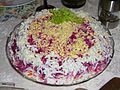 Herring as food
 -
 Herring as food
 -
 Herring as food
 -
 Herring as food
 -
 Herring as food


.jpg)


Medical Disclaimer: WikiMD is for informational purposes only and is not a substitute for professional medical advice. Content may be inaccurate or outdated and should not be used for diagnosis or treatment. Always consult your healthcare provider for medical decisions. Verify information with trusted sources such as CDC.gov and NIH.gov. By using this site, you agree that WikiMD is not liable for any outcomes related to its content. See full disclaimer.
Credits:Most images are courtesy of Wikimedia commons, and templates, categories Wikipedia, licensed under CC BY SA or similar.
Translate page: - East Asian
中文,
日本,
한국어,
South Asian
हिन्दी,
தமிழ்,
తెలుగు,
Urdu,
ಕನ್ನಡ,
Southeast Asian
Indonesian,
Vietnamese,
Thai,
မြန်မာဘာသာ,
বাংলা
European
español,
Deutsch,
français,
Greek,
português do Brasil,
polski,
română,
русский,
Nederlands,
norsk,
svenska,
suomi,
Italian
Middle Eastern & African
عربى,
Turkish,
Persian,
Hebrew,
Afrikaans,
isiZulu,
Kiswahili,
Other
Bulgarian,
Hungarian,
Czech,
Swedish,
മലയാളം,
मराठी,
ਪੰਜਾਬੀ,
ગુજરાતી,
Portuguese,
Ukrainian

