Nitrate
Nitrate is a polyatomic ion with the molecular formula NO3−. It is the conjugate base of nitric acid, consisting of one central nitrogen atom surrounded by three identically bonded oxygen atoms in a trigonal planar arrangement. The nitrate ion carries a formal charge of −1. This results from a combination of the +5 oxidation state of the nitrogen and the −2 oxidation state of the oxygen.
Properties[edit]
Nitrates are common components of fertilizers and explosives. Almost all nitrates are soluble in water. A common example of an inorganic nitrate salt is potassium nitrate (saltpeter).
Health effects[edit]
Ingested nitrate is reduced to nitrite (NO2−) by bacteria in the mouth or gastrointestinal tract. In the body, nitrite easily oxidizes to form nitrate. This is an endogenous source of nitrate in bodily secretions, which can be converted to nitrite and cause health problems.
See also[edit]
References[edit]

This WikiMD article can only be edited by registered and verified editors. You can log in or register.
-
 Nitrate ion with partial charges
 -
 Nitrate ion resonance structures
 -
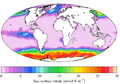 Annual mean sea surface nitrate (World Ocean Atlas 2009)
 -
 Nitrate and Phosphate in the Pacific Ocean


.png)

Advertise on WikiMD — 81,000+ full articles, ~900,000 total pages, ~250 million page views. Global reach, limited time promotional rates from $1/page/day. Learn more · View stats


Translate page: - East Asian
中文,
日本,
한국어,
South Asian
हिन्दी,
தமிழ்,
తెలుగు,
Urdu,
ಕನ್ನಡ,
Southeast Asian
Indonesian,
Vietnamese,
Thai,
မြန်မာဘာသာ,
বাংলা
European
español,
Deutsch,
français,
Greek,
português do Brasil,
polski,
română,
русский,
Nederlands,
norsk,
svenska,
suomi,
Italian
Middle Eastern & African
عربى,
Turkish,
Persian,
Hebrew,
Afrikaans,
isiZulu,
Kiswahili,
Other
Bulgarian,
Hungarian,
Czech,
Swedish,
മലയാളം,
मराठी,
ਪੰਜਾਬੀ,
ગુજરાતી,
Portuguese,
Ukrainian
About WikiMD • Contact • Disclaimer • Privacy • Copyright • Site statistics
Some content and images may originate from Wikimedia Commons or Wikipedia and remain subject to their stated licenses. Unless otherwise noted, eligible WikiMD content is available under CC BY-SA 4.0.
WikiMD Wellnesspedia — Free health & wellness information for patients, students, and health professionals.

