Salami: Difference between revisions
CSV import Tags: mobile edit mobile web edit |
No edit summary |
||
| Line 1: | Line 1: | ||
Salami | [[File:Salame di Sauris.jpg|Salame di Sauris|thumb]] | ||
[[File:Salumi in Bologna.jpg|Salumi in Bologna|thumb|left]] | |||
[[File:Herz szalámi plakát.jpg|Herz szalámi plakát|thumb]] | |||
[[File:3 Salami.JPG|3 Salami|left|thumb]] | |||
'''Salami''' is a type of [[cured sausage]] consisting of [[fermented]] and [[air-dried meat]], typically [[pork]]. Historically, salami has been popular among [[Southern European]] [[peasants]] because it can be stored at room temperature for up to 40 days once cut, supplementing a potentially meager or inconsistent supply of fresh meat. | '''Salami''' is a type of [[cured sausage]] consisting of [[fermented]] and [[air-dried meat]], typically [[pork]]. Historically, salami has been popular among [[Southern European]] [[peasants]] because it can be stored at room temperature for up to 40 days once cut, supplementing a potentially meager or inconsistent supply of fresh meat. | ||
| Line 28: | Line 30: | ||
While salami can be a flavorful addition to meals, it is important to be aware of its high sodium content, which can contribute to [[hypertension]] if consumed in excess. Additionally, some salami varieties may contain [[nitrates]] and [[nitrites]], which are used as preservatives but have been linked to health concerns. | While salami can be a flavorful addition to meals, it is important to be aware of its high sodium content, which can contribute to [[hypertension]] if consumed in excess. Additionally, some salami varieties may contain [[nitrates]] and [[nitrites]], which are used as preservatives but have been linked to health concerns. | ||
== Gallery == | |||
<gallery> | |||
File:Telaio porta salami - Musei del cibo - salame - 052.tif|Telaio porta salami - Musei del cibo | |||
File:Salumi Valli Unite.jpg|Salumi Valli Unite | |||
File:Pane e Salame.jpg|Pane e Salame | |||
File:Salame ticinese.jpg|Salame ticinese | |||
File:Finocchiona from Tuscany.JPG|Finocchiona from Tuscany | |||
File:Salame friulano 01.jpg|Salame friulano | |||
</gallery> | |||
== See Also == | == See Also == | ||
* [[Charcuterie]] | * [[Charcuterie]] | ||
| Line 38: | Line 49: | ||
== External Links == | == External Links == | ||
* [ | * [https://www.nationalsalamiday.com National Salami Day] | ||
{{Meat}} | {{Meat}} | ||
{{Sausages}} | {{Sausages}} | ||
[[Category:Meat products]] | [[Category:Meat products]] | ||
[[Category:Sausages]] | [[Category:Sausages]] | ||
[[Category:Italian cuisine]] | [[Category:Italian cuisine]] | ||
[[Category:Fermented foods]] | [[Category:Fermented foods]] | ||
Latest revision as of 03:59, 24 February 2025


Salami is a type of cured sausage consisting of fermented and air-dried meat, typically pork. Historically, salami has been popular among Southern European peasants because it can be stored at room temperature for up to 40 days once cut, supplementing a potentially meager or inconsistent supply of fresh meat.
Ingredients[edit]
Salami is made from a mixture of meat, fat, wine, salt, and various herbs and spices. The ingredients are usually combined with lactic acid bacteria to aid in the fermentation process. Common spices include garlic, pepper, and fennel.
Production Process[edit]
The production of salami involves several steps:
- Preparation of Meat and Fat: The meat and fat are ground to the desired consistency.
- Mixing: The ground meat and fat are mixed with salt, spices, and other ingredients.
- Stuffing: The mixture is stuffed into casings, which can be natural or synthetic.
- Fermentation: The stuffed salami is left to ferment, allowing beneficial bacteria to develop.
- Drying: The salami is hung to dry in a controlled environment, which can take several weeks to months.
Types of Salami[edit]
There are many varieties of salami, each with unique characteristics:
- Genoa Salami: Made with pork and seasoned with garlic, salt, and pepper.
- Soppressata: A coarsely ground salami with a robust flavor, often made with red pepper flakes.
- Pepperoni: A spicy salami commonly used as a pizza topping in the United States.
Nutritional Information[edit]
Salami is a rich source of protein and fat, but it is also high in sodium and calories. It should be consumed in moderation as part of a balanced diet.
Health Considerations[edit]
While salami can be a flavorful addition to meals, it is important to be aware of its high sodium content, which can contribute to hypertension if consumed in excess. Additionally, some salami varieties may contain nitrates and nitrites, which are used as preservatives but have been linked to health concerns.
Gallery[edit]
-
 Telaio porta salami - Musei del cibo
 -
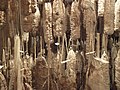 Salumi Valli Unite
 -
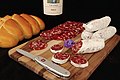 Pane e Salame
 -
 Salame ticinese
 -
 Finocchiona from Tuscany
 -
 Salame friulano


See Also[edit]
References[edit]
- "The Art of Making Fermented Sausages" by Stanley Marianski
- "Charcuterie: The Craft of Salting, Smoking, and Curing" by Michael Ruhlman
External Links[edit]
| Meat | ||||||||||
|---|---|---|---|---|---|---|---|---|---|---|
|
| Sausage | ||||||||||
|---|---|---|---|---|---|---|---|---|---|---|
* Category
|
