Mediastinitis: Difference between revisions
From WikiMD's Wellness Encyclopedia
No edit summary Tag: visualeditor-wikitext |
CSV import |
||
| Line 116: | Line 116: | ||
[[Category:IgG4-related disease]] | [[Category:IgG4-related disease]] | ||
{{stub}} | {{stub}} | ||
<gallery> | |||
File:Mediastinum.jpg|Mediastinum | |||
File:Mediastinum.png|Mediastinum | |||
File:CT scan of a patient with Descending Necrotizing Mediastinitis.jpg|CT scan of a patient with Descending Necrotizing Mediastinitis | |||
</gallery> | |||
Latest revision as of 01:25, 20 February 2025
Inflammatory process affecting the mediastinum
| Mediastinitis | |
|---|---|

| |
| Synonyms | |
| Pronounce | |
| Field | |
| Symptoms | |
| Complications | |
| Onset | |
| Duration | |
| Types | |
| Causes | |
| Risks | |
| Diagnosis | |
| Differential diagnosis | |
| Prevention | |
| Treatment | |
| Medication | |
| Prognosis | |
| Frequency | |
| Deaths | |
An inflammatory process affecting the mediastinum.
Types[edit]
Mediastinitis can be acute or chronic, depending on the onset.
Risk factors[edit]
It most often occurs in person who recently had an upper endoscopy or chest surgery.
- A person may have a tear in their esophagus that causes mediastinitis.
- Disease of the esophagus
- Diabetes mellitus
- Problems in the upper gastrointestinal tract
- Recent chest surgery or endoscopy
- Weakened immune system
Causes[edit]
Causes of the tear include:
- A procedure such as endoscopy
- Forceful or constant vomiting
- Trauma
- A fungal infection called histoplasmosis
- Radiation
- Inflammation of the lymph nodes, lungs, liver, eyes, skin, or other tissues (sarcoidosis)
- Tuberculosis
- Breathing in anthrax
- Cancer
Signs and symptoms[edit]
- Chest pain
- Chills
- Fever
- General discomfort
- Shortness of breath
Signs of mediastinitis in people who have had recent surgery include:
- Chest wall tenderness
- Wound drainage
- Unstable chest wall
Investigations[edit]
Tests may include:
- Chest CT scan or MRI scan
- Chest x-ray
- Ultrasound
- MRI of the chest
Treatment[edit]
You may receive antibiotics if you have an infection.
You may need surgery to remove the area of inflammation if the blood vessels, windpipe, or esophagus is blocked.
Prognosis[edit]
- How well a person does depends on the cause and severity of the mediastinitis.
- Mediastinitis after chest surgery is very serious. There is a risk of dying from the condition.
Complications[edit]
Complications include the following:
- Spread of the infection to the bloodstream, blood vessels, bones, heart, or lungs
- Scarring - Scarring can be severe, especially when it is caused by chronic mediastinitis. Scarring can interfere with heart or lung function.
Prevention[edit]
- To lessen the risk of developing mediastinitis related to chest surgery, surgical wounds should be kept clean and dry after surgery.
- Treating tuberculosis, sarcoidosis, or other conditions associated with mediastinitis may prevent this complication.
Alternative Names: Chest infection
External links[edit]
- Mediastinitis at the US National Library of Medicine Medical Subject Headings (MeSH)
| Diseases of the respiratory system | ||||||||||||||||||||||||||||||||||||||
|---|---|---|---|---|---|---|---|---|---|---|---|---|---|---|---|---|---|---|---|---|---|---|---|---|---|---|---|---|---|---|---|---|---|---|---|---|---|---|
|
 |
 |
-
 Mediastinum
 -
 Mediastinum
 -
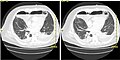 CT scan of a patient with Descending Necrotizing Mediastinitis


